


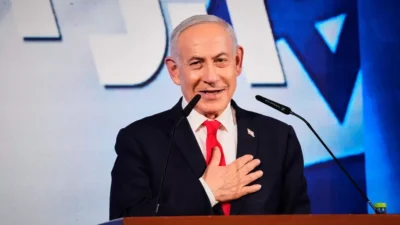
Israel’s national election has produced no immediate clear winner, with early projections pointing to a closely divided political landscape and the prospect of difficult coalition negotiations.
Exit polls initially placed Prime Minister Benjamin Netanyahu’s bloc and the opposition grouping associated with Gadi Eisenkot at 51 seats each. Neither side appeared to have secured the 61 seats required for a majority in the 120-member Knesset.
As counting continued on Wednesday morning, the Likud party led with approximately 20.6 per cent of the vote, ahead of Eisenkot’s Yashar party at 16.8 per cent, according to the Associated Press.
The emerging results suggest that the final composition of the next government may depend on coalition-building among parties that did not secure enough seats to govern independently.
Arab-led parties also performed strongly, potentially increasing their influence in negotiations over parliamentary support and the formation of a government.
Netanyahu said Likud would emerge as the largest party and reiterated his position on security and Iran. Eisenkot, meanwhile, campaigned on national unity and political change.
President Isaac Herzog is expected to select the candidate best positioned to form a government after the electoral process becomes clearer. Netanyahu remains caretaker prime minister during the transition.
With the final parliamentary balance still uncertain, the election’s immediate significance lies in the negotiations that will determine the next governing coalition and its policy direction.
RELATED NEWS:
- Prof. Ladan Calls for Issue-Based Political Campaigns to Protect Nigeria’s Democracy
- Supreme Court Restores Electoral Act Rules on Primaries


behind Games Village, Abuja
5A, CGH, Games Village, Abuja