


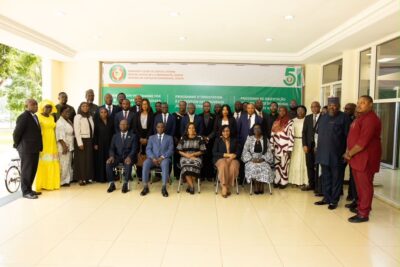
The President of the Community Court of Justice, ECOWAS, Hon. Justice Charlyne M. Brumskine, has urged the Court’s newly appointed judges to uphold independence and integrity, reduce delays and strengthen engagement with Member States on the enforcement of judgments.
She outlined the priorities on Monday, October 19, 2026, while opening a five-day orientation programme at Zuma Rock Resort, Niger State, Nigeria. The programme, which runs until October 23, is being held under the theme, “Becoming an ECOWAS Judge: Judicial Excellence, Institutional Integration and Effective Adjudication.”
Addressing her colleagues, Justice Brumskine identified independence and integrity, collegiality, and effectiveness as three commitments that should guide the new College of Judges.
On the responsibility to deliver timely and effective justice, she stated:
“The third is effectiveness – we inherit a substantial caseload, and the Community expects timely justice. We must therefore work diligently to reduce delays, to make full use of our Electronic Case Management System, and to align our work with the priorities of the Court’s Strategic Plan 2026–2030. We must also continue to engage Member States on the enforcement of the Court’s judgments, for a judgment that is not implemented does not deliver the justice it promises.”
The President emphasised that the Court’s authority depends on the confidence of litigants, Member States and citizens of the Community. She urged judges to maintain the highest standards of independence, impartiality and personal conduct, both on and off the bench.
“That confidence is earned, case by case, through fairness, impartiality and integrity, and it can be lost by a single lapse.”
She also stressed the importance of collective responsibility and consistent jurisprudence.
“The second is collegiality – a Court is not a collection of individual Judges; it is a single institution that speaks with one voice through its decisions. Our strength lies in rigorous deliberation, mutual respect and a shared commitment to coherent and consistent jurisprudence. I look forward to building that culture with each of you.”
Justice Brumskine acknowledged the experience the judges bring from national benches, legal practice and public service. However, she explained that service at the ECOWAS Court requires an understanding of its distinct legal order, the Community instruments defining its mandate and the jurisprudence developed over more than two decades.
She noted that the Court operates across Member States with different legal traditions, languages and judicial cultures. Its responsibilities include interpreting and applying Community law, protecting human rights and settling disputes between the Community and its staff.
The orientation, she said, provides an opportunity to develop a common institutional vision and become familiar with the practical demands of those responsibilities.
Justice Brumskine also underscored the value of institutional memory, particularly as an entirely new College of Judges assumes office together. She thanked Professor Friday C. Nwoke, a former Vice-President of the Court, for serving as a resource person, alongside officers whose experience supports the institution’s daily work.
Recognising the contribution of staff, she said:
“The effectiveness of this Court depends on a relationship between Judges and staff founded on mutual respect, clarity of roles and a shared institutional purpose.”
The programme combines judicial induction with practical briefings on the Court’s administrative and operational arrangements.
According to the Court’s Public Information and External Relations Division, sessions will cover sources of law and interpretation, admissibility and access to the Court, reparations and remedies, judicial ethics and conduct, and the responsibilities of judges within a collegial institution.
Participants will also receive hands-on experience with the Electronic Case Management System, intended to support efficient case management and improve access to justice.
Other sessions will examine registry operations, case-flow management, research and documentation, administration and finance, information technology, security, protocol, planning, monitoring and evaluation, and public information and external relations.
The Court’s Strategic Plan 2026–2030, tagged Justice 2030, forms a central component of the programme. It provides the institutional framework for advancing effectiveness, accessibility, efficiency and accountability.
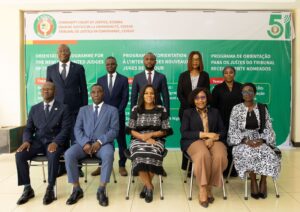
The new College comprises Justice Brumskine as President; Hon. Justice Désire Henri Aihou as Vice-President; and Hon. Justices Henrietta Uzoamaka Didigu, Yaouza Ouro-Sama and Awa Bah as members.
Presenting the programme’s objectives and expectations, Acting Chief Registrar Dr. Ousmane Diallo said it was designed to support the integration of the judges and their Executive Assistants into the Court’s institutional and operational environment.
He explained that the exercise would introduce the expertise available within the institution, clarify responsibilities and communication channels, and provide the knowledge needed for the new College to determine its priorities and working methods.
Dr. Diallo placed particular emphasis on judicial independence, specifying that the orientation should not be perceived as directing or influencing the exercise of judicial functions.
He also identified confidentiality, professionalism, mutual respect and staff adaptability as guiding principles. Existing procedures, he explained, should serve as institutional experience upon which future arrangements could be built, while allowing the new leadership to determine its approach within the applicable legal framework.
Among the expected outcomes are stronger coordination, improved readiness of Executive Assistants, clearer support arrangements and the identification of practical issues requiring follow-up.
Assuring the judges of the commitment of the Court’s personnel, Dr. Diallo stated:
“On behalf of the entire staff of the Court, I assure Your Lordships of our full commitment, loyalty and support in the discharge of your judicial functions.”
Please find attached the full opening address delivered by Hon. Justice Charlyne M. Brumskine, President of the Community Court of Justice, ECOWAS, at the orientation programme for the newly appointed judges on October 19, 2026.
Opening Speech – Hon President Charlyne Brumskine at Orientation Prog for New Judges
Photos:

Related news
- ECOWAS Court Elects Brumskine President, Aihou Vice-President
- Faye Charges New ECOWAS Court Judges to Protect Trust, Rights and Judicial Independence
- ECOWAS Court’s New President Pledges Timely Justice


behind Games Village, Abuja
5A, CGH, Games Village, Abuja