

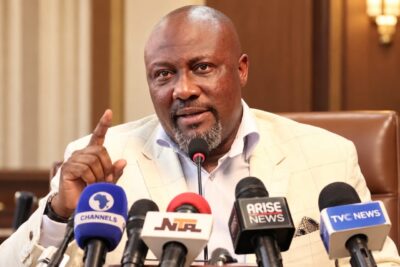
Former Senator and legal practitioner, Senator Dino Melaye, Esq., has accused the leadership of Nigeria’s 10th National Assembly of surrendering its constitutional independence to the Presidency, warning that the continued weakening of legislative oversight could create the conditions for an increasingly powerful and largely unchecked presidency.
Melaye made the allegations during a press conference held on Wednesday, October 14, 2026, where he delivered an extensive assessment of the National Assembly under Senate President Godswill Akpabio and Speaker of the House of Representatives, Tajudeen Abbas.
Addressing journalists under the theme, “The 10th Assembly: The Pathway to Tinubu’s ‘Lifetime Presidency’,” the former lawmaker questioned whether the National Assembly had become, in practical terms, another department of the Presidential Villa rather than an independent arm of government.
His presentation examined several legislative and constitutional controversies between July 2024 and September 2026, including amendments to the Police Act, the declaration of emergency rule in Rivers State, discrepancies in Nigeria’s tax legislation, electoral reforms, budget implementation, constitutional amendment procedures and legislative oversight of federal security institutions.
Melaye argued that although the National Assembly had continued to perform legislative functions, the more important question was whether it had demonstrated sufficient independence when confronted with decisions requiring constitutional restraint on executive power.
“A lifetime presidency does not begin with the abolition of term limits. It begins when the institutions created to restrain a President stop restraining him,” he declared.
According to him, Nigeria’s Constitution establishes a presidential democracy founded on the separation of powers, not a political arrangement in which Parliament exists merely to endorse executive decisions.
He maintained that cooperation between the Executive and Legislature was necessary for effective governance but insisted that such cooperation must never become institutional submission.
“The President may request. Parliament must scrutinise. The President may propose. Parliament may accept, amend or reject. The President may exercise power. Parliament must ensure that power remains within the Constitution,” Melaye stated.
Police Act Amendment: Melaye Questions Legislative Speed and Institutional Independence
One of the earliest developments highlighted in Melaye’s presentation was the July 23, 2024 amendment to the Nigeria Police Act 2020.
He recalled that President Bola Ahmed Tinubu transmitted an Executive Bill seeking to permit an appointed Inspector-General of Police to remain in office until the expiration of the tenure stated in the appointment letter, notwithstanding the ordinary retirement requirements applicable to police officers.
Melaye questioned why legislation affecting the tenure of the head of a major national security institution passed through all three readings in both chambers within a single day.
He argued that the extraordinary speed of the legislative process raised legitimate questions about the level of scrutiny undertaken by lawmakers.
The former senator identified former Inspector-General of Police Kayode Egbetokun as the immediate beneficiary of the amendment, noting his previous service as Chief Security Officer to Tinubu during the latter’s tenure as Governor of Lagos State.
He also referred to the subsequent appointment of Olatunji Disu, who had previously served as Tinubu’s Aide-de-Camp.
Melaye was careful to distinguish his concerns about institutional safeguards from allegations of personal misconduct.
He acknowledged that previous professional service to a political officeholder did not establish partisanship or wrongdoing.
However, he questioned whether Parliament had established adequate safeguards to protect the political neutrality of the Police, particularly during elections.
He noted that the Nigeria Police Force plays a central role in securing polling units, election materials, collation centres and electoral officials.
According to him, the central concern was not whether a particular Inspector-General could be trusted, but whether the law adequately protected the office from any perception of political indebtedness.
Melaye argued that democratic institutions should not depend solely on public confidence in the personal integrity of their occupants.
Rivers Emergency Rule: Questions Over Constitutional Voting Requirements
Turning to the March 18, 2025 declaration of emergency rule in Rivers State, Melaye challenged the procedure adopted by the National Assembly in approving the presidential proclamation.
He cited Section 305(6)(b) of the 1999 Constitution, which requires approval by a two-thirds majority of all members of each chamber.
According to his presentation, both chambers approved the proclamation through voice votes without a recorded numerical vote establishing whether the constitutional threshold had been satisfied.
Melaye argued that extraordinary presidential powers demanded equally rigorous constitutional safeguards.
He questioned why lawmakers did not conduct a recorded vote capable of demonstrating compliance with the required majority.
“When the Constitution requires two-thirds of all members, should Nigerians not be entitled to know precisely who constituted that two-thirds?” he asked.
He maintained that the controversy went beyond political support for emergency rule and raised fundamental questions about constitutional procedure.
Tax Laws Controversy: Melaye Demands Accountability Over Alleged Alterations
The former senator also raised concerns about discrepancies identified between versions of Nigeria’s 2025 tax legislation.
He referred to the findings of a House of Representatives ad-hoc committee, which reportedly identified differences between Certified True Copies of legislation and versions subsequently gazetted or circulated.
Although the House leadership later released certified copies of the legislation, Melaye argued that publication of the authentic text did not adequately resolve questions about how the discrepancies arose.
He demanded answers concerning the custody of the legislation, the stage at which the differences emerged and whether any unauthorised alterations occurred.
“Correction is not accountability,” he said.
Melaye maintained that Parliament must protect the integrity of its legislative processes and ensure that laws presented to the public accurately reflect what elected representatives approved.
He warned that failure to establish accountability in such circumstances could undermine public confidence in the lawmaking process.
Electoral Act 2026: Melaye Challenges House Voting Procedure
Another major issue raised during the briefing was the controversy surrounding amendments to the Electoral Act.
Melaye recalled proceedings of February 17, 2026, when the House of Representatives considered a motion to rescind its earlier position on mandatory real-time electronic transmission of election results.
He alleged that when Speaker Tajudeen Abbas put the motion to a voice vote, opposition to the proposal appeared louder than support, yet the Speaker ruled that the motion had been carried.
The former senator said the resulting protests demonstrated the seriousness of concerns surrounding parliamentary procedure.
He argued that the authority of a presiding officer must be exercised to determine the will of the House, not substitute for it.
Melaye further questioned the removal of lack of qualification as an express ground for challenging an election under Section 138 of the Electoral Act 2026.
He contrasted the provision with Section 134 of the Electoral Act 2022, which expressly permitted election petitions challenging whether a candidate was qualified at the time of an election.
While acknowledging that constitutional qualification requirements remained in force and that pre-election remedies continued to exist, Melaye questioned the practical consequences of removing the express post-election ground.
He asked what remedies would remain where a qualification issue emerged after an election or was not challenged before polling.
The former lawmaker did not present evidence that the amendment was specifically designed to protect President Tinubu or another politician.
Rather, he called for closer examination of the consequences of narrowing available election-petition remedies.
Budget Implementation: Melaye Accuses Parliament of Weakening Oversight
On public finance, Melaye criticised what he described as repeated failures to ensure effective implementation of Appropriation Acts.
He cited President Tinubu’s acknowledgment that approximately ₦3.10 trillion, representing about 17.7 per cent of the 2025 capital budget, had been released by the third quarter of that year.
According to him, the continued extension of budget implementation periods and the passage of successive budgets without sufficient accountability raised serious concerns about Parliament’s exercise of its constitutional powers.
“An Appropriation Act is not an executive aspiration. It is law,” he declared.
Melaye also referred to a July 2026 statement attributed to Senate Chief Whip Tahir Monguno, who reportedly described failure to implement an Appropriation Act as an impeachable offence.
He acknowledged that whether such failure would legally satisfy the constitutional requirements for impeachment remained a separate question.
However, he argued that Parliament must explain what measures it had adopted to address persistent budget implementation failures.
₦26.22 Trillion Service-Wide Votes: Melaye Questions Spending Transparency
A substantial portion of the briefing focused on allocations to Service-Wide Votes between 2024 and 2026.
Melaye cited approximately ₦4.08 trillion in 2024, ₦9.31 trillion in 2025 and ₦12.83 trillion in 2026, bringing the combined allocation to approximately ₦26.22 trillion.
He stressed that the allocations were not, by themselves, evidence of corruption.
Nevertheless, he questioned whether legislative scrutiny had increased in proportion to the growth in centrally managed expenditure.
The former senator referred to an earlier House of Representatives resolution to investigate alleged abuses of Service-Wide Votes and demanded public disclosure of the investigation’s findings and any resulting reforms.
He also acknowledged the Budget Office’s explanation that the 2026 allocation included identifiable personnel, recurrent and capital expenditure obligations.
According to Melaye, such explanations did not eliminate Parliament’s responsibility to trace expenditure and demand accountability from recipient institutions.
He further referred to International Monetary Fund estimates concerning statistical discrepancies in Nigeria’s government financial reporting.
Using the figures cited in his briefing, he calculated that a discrepancy equivalent to 2.7 per cent of the country’s estimated 2025 GDP would amount to approximately ₦11.9 trillion.
He expressly clarified that the calculation did not constitute an IMF allegation that ₦11.9 trillion had been stolen.
Rather, he argued that the findings raised important questions about expenditure reporting, budgetary controls and legislative oversight.
Melaye questioned whether the National Assembly had adequately interrogated spending subsequently incorporated into budgets through repeal-and-re-enactment legislation.
He also expressed concern about the proximity of the 2026 fiscal year to the 2027 general elections, while acknowledging that the timing alone did not establish any diversion of public funds for electoral purposes.
Six-Year Presidential Term: Melaye Raises Concerns Over Possible Tenure Extension
Melaye also addressed discussions surrounding a proposed constitutional amendment introducing a single six-year term for presidents and governors.
He referred to a June 2026 announcement attributed to Senate Leader Opeyemi Bamidele concerning plans to introduce such legislation in the 11th Senate after the 2027 general election.
While acknowledging arguments in favour of a single-term presidency, Melaye questioned the proposed timing.
He argued that any amendment introduced after the 2027 presidential election must contain clear safeguards preventing an incumbent from benefiting retrospectively from a change in tenure.
According to him, President Tinubu’s current constitutional tenure arrangement would ordinarily conclude in 2031 if he secured a second four-year mandate in 2027.
However, Melaye warned that a future amendment drafted to extend an incumbent’s four-year mandate to six years could theoretically produce a different outcome.
He illustrated the concern by suggesting that such an arrangement could extend Tinubu’s presidency to 2033.
The former senator emphasised that no existing enacted provision presently produces that result and that the consequences of any future amendment would depend on its actual wording and transitional provisions.
He insisted that Nigerians must scrutinise any proposal affecting presidential tenure before its passage.
State Police Amendment: Melaye Questions Virtual Participation in Constitutional Voting
The former senator also challenged the procedure reportedly adopted during the House of Representatives’ consideration of constitutional amendments relating to state policing in July 2026.
He recalled that Speaker Abbas announced the participation of 276 members physically present and another 35 participating virtually.
According to Melaye, the resulting figure of 311 exceeded the two-thirds threshold of 240 members required in the 360-member House.
However, he argued that the central question was not the arithmetic but the constitutional validity of counting virtual participation toward the special majority required for constitutional alteration.
He questioned whether an ordinary parliamentary resolution could determine the procedure for satisfying a voting threshold expressly established by the Constitution.
Melaye warned that procedural precedents established during debates on state policing could eventually affect more consequential constitutional questions, including presidential tenure.
Minna Custody Deaths: Melaye Demands Independent Legislative Investigation
Addressing the deaths of 37 persons reportedly held in the custody of the Nigeria Security and Civil Defence Corps in Niger State, Melaye questioned the National Assembly’s response to the September 17, 2026 incident.
He acknowledged the Federal Government’s establishment of an investigative committee, the suspension of officers connected to the incident and the commencement of a police investigation.
However, he maintained that executive investigations could not replace independent legislative oversight.
Melaye demanded to know whether relevant parliamentary committees had summoned NSCDC officials or commenced their own public investigation into the circumstances surrounding the deaths.
He questioned whether the Legislature intended to rely entirely on an investigation established by the Executive into an agency operating under executive authority.
According to him, the separation of powers requires independent scrutiny, particularly where serious failures within federal institutions result in loss of life.
Tinubu’s Vacation: Melaye Questions National Assembly’s Interpretation of Section 145
Melaye further examined President Tinubu’s absence from Nigeria between August 30 and September 29, 2026.
He referred to Section 145 of the Constitution, which provides for the transmission of a written declaration when the President proceeds on vacation or is otherwise unable to discharge the functions of office.
He also cited subsection (2), which addresses circumstances where a President is unable or fails to transmit the required declaration within 21 days.
The former senator acknowledged the Presidency’s position that Tinubu continued directing government affairs remotely and that Vice-President Kashim Shettima represented him at certain official engagements.
However, he argued that Parliament owed Nigerians a clear explanation of its constitutional interpretation.
He questioned whether the President’s ability to communicate electronically removed the need to comply with constitutional provisions governing presidential absence.
Melaye recalled the constitutional crisis surrounding the prolonged medical absence of former President Umaru Musa Yar’Adua, which ultimately led to reforms intended to clarify the transfer of presidential authority.
He insisted that the National Assembly must explain whether Section 145 was applicable in the circumstances and, if not, the constitutional basis for that conclusion.
Public Confidence in Parliament at Risk, Melaye Warns
Beyond the individual controversies, Melaye argued that the greatest danger was the gradual erosion of public confidence in democratic institutions.
He cited Afrobarometer findings indicating that 64 per cent of Nigerians still preferred democracy to other forms of government.
He also referred to the Africa Polling Institute’s 2026 Social Cohesion Report, which he said showed that only 23 per cent of respondents expressed significant trust in the National Assembly, while 77 per cent expressed little or no trust.
Melaye acknowledged that the figures did not establish a direct causal relationship between the controversies identified in his briefing and declining institutional confidence.
Nevertheless, he argued that Parliament’s perceived inability to restrain executive power could further weaken citizens’ belief in democratic governance.
According to him, elections alone cannot sustain democracy where citizens lose confidence in the institutions responsible for protecting constitutional limits.
‘National Assembly Must Decide What It Is’
In his concluding remarks, Melaye maintained that his criticism was directed at the constitutional performance of the institutions led by Akpabio and Abbas rather than their personalities.
He argued that the National Assembly must defend its legislative authority, demand transparency in public expenditure, enforce constitutional voting requirements and independently investigate failures within federal institutions.
The former senator clarified that his use of the expression “lifetime presidency” was an institutional warning rather than an assertion that President Tinubu had abolished term limits or established a plan to remain in office indefinitely.
He explained that his concern was the possibility of a presidency exercising increasingly extensive powers without effective institutional restraint.
For Melaye, the cumulative significance of the controversies was more important than any single legislative decision.
He warned that procedural shortcuts accepted under one administration could become precedents available to future governments, regardless of political affiliation.
The former senator concluded by reminding the leadership of the National Assembly that its constitutional responsibilities extended beyond political loyalty to the President.
“The oath they took was to the Constitution, not to the President,” Melaye declared.
He warned that history might forgive a Parliament that confronted a powerful President and failed, but would be less forgiving of one that never seriously asserted the constitutional powers entrusted to it.
The October 14 briefing ultimately placed the independence of the National Assembly at the centre of Nigeria’s continuing debate over constitutional governance, executive accountability and the future of democratic institutions ahead of the 2027 general elections.
- SENATOR DINO MELAYE AT THE INTERNATIONAL BAR ASSOCIATION CONFERENCE, COPENHAGEN, DENMARK – 8TH OCTOBER, 2026
- Dino Melaye: Nigeria Must Learn From Brazil’s Election System

behind Games Village, Abuja
5A, CGH, Games Village, Abuja