


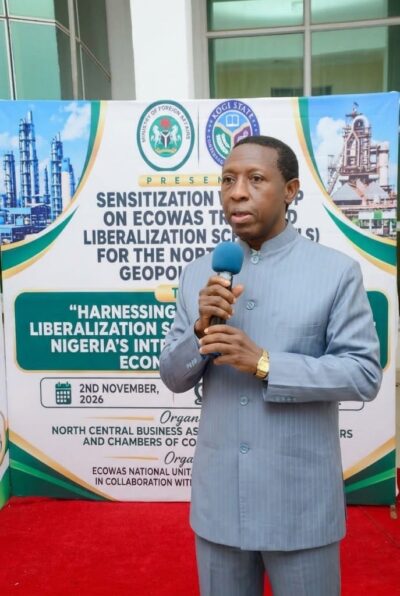
The proposal is contained in a paper titled “The Complementarity of ETLS and AfCFTA Operational Frameworks as a Dual Track Strategy for Integrating Regional Economies of Nigeria into the ECOWAS Common and AfCFTA Single Market Access: Case Study of North Central States of Nigeria.”
The paper was prepared for a programme organised by the Ministry of Foreign Affairs, Abuja, under the theme, “Increasing Intra-Regional Trade Through ECOWAS Trade Liberalization Scheme (ETLS).”
The programme is scheduled to hold from November 1 to 3, 2026, at Government House, Lokoja, Kogi State.
Professor Ladan, who currently serves as Coordinating Director of the AfCFTA Law and Policy Programme Division at the National Institute for Legislative and Democratic Studies (NILDS), Abuja, and is a former Director-General of the Nigerian Institute of Advanced Legal Studies (NIALS), argues that Nigeria should not treat ETLS and AfCFTA as competing trade arrangements.
Rather, he maintains that their operational relationship offers Nigerian businesses, micro, small and medium-sized enterprises (MSMEs), manufacturers and cross-border traders an opportunity to access both the West African regional market and the wider African continental market.
Two Trade Frameworks, One Expansion Strategy
At the centre of the paper is the argument that ETLS provides an established regional platform through which eligible Nigerian products can access ECOWAS markets, while AfCFTA offers a wider framework for expanding trade into other parts of Africa.
The paper explains that the ECOWAS framework can serve as an initial market-entry platform, allowing businesses to establish their export capacity, understand regional customs procedures and develop supply chains before expanding into more distant African markets under AfCFTA.
It further argues that the continental framework creates opportunities for Nigerian businesses to move beyond the limitations of domestic demand and participate in wider African production and distribution networks.
Using comparative market estimates presented in the paper, Professor Ladan places Nigeria’s domestic population at approximately 230 million, the ECOWAS regional market at between 400 million and 446 million people, and the AfCFTA continental market at approximately 1.4 billion consumers.
The paper identifies the scale of the continental market as a significant opportunity for Nigerian enterprises seeking to expand production, improve competitiveness and diversify their export destinations.
Focus on North-Central Nigeria’s Economic Potential
A major component of the study is its examination of the economic and productive capacity of the six North-Central states: Benue, Kogi, Kwara, Nasarawa, Niger and Plateau.
Professor Ladan identifies agriculture, livestock commercialisation, agro-allied processing and solid minerals beneficiation as sectors capable of strengthening the region’s participation in regional and continental trade.
The paper provides state-specific profiles of their economic assets and proposed export opportunities.
Benue State is highlighted for its production of yam, cassava, soybeans and sesame seeds, with emphasis on processing agricultural commodities into products such as soybean meal and refined oil.
Nasarawa State is examined for its solid mineral deposits, particularly lithium, alongside opportunities in ginger, sesame and rice processing. The paper advocates local beneficiation rather than the export of unprocessed mineral resources.
Niger State is profiled for its agricultural production capacity, livestock development and mineral resources, with recommendations directed at strengthening processing and export infrastructure.
Kogi State’s iron ore, limestone, coal, cashew and cassava resources are identified as important assets, with opportunities for gemstone processing, jewellery production and value-added cashew exports.
Plateau State’s production of Irish potatoes, vegetables, flowers and strawberries, alongside its tin, columbite and gemstone deposits, is presented as a basis for developing agro-processing and mineral-refining activities.
Kwara State is similarly identified as a potential processing hub, particularly for shea butter, cashew nuts and poultry products.
The central argument is that these states should move beyond the sale of primary commodities and invest in processing, packaging and other forms of value addition that can improve their competitiveness in African markets.
Rules of Origin and Access to Duty-Free Markets
The paper also examines the rules of origin governing access to preferential trade arrangements under ETLS and AfCFTA.
It explains that products must satisfy the applicable origin requirements to qualify for preferential treatment, including goods wholly produced within the region and manufactured products that meet the relevant local-content, value-addition or substantial-transformation criteria.
For industrial products, the paper discusses criteria including local raw-material content, value addition and changes in tariff classification.
It further outlines the approval and documentation requirements Nigerian exporters must navigate, including business registration, export certification, customs documentation and relevant product-specific regulatory approvals.
The study emphasises that awareness of these requirements is essential for MSMEs and local producers seeking to benefit from preferential market access.
Trade Infrastructure and Administrative Barriers Remain Major Challenges
Despite the opportunities presented by the two frameworks, Professor Ladan identifies several structural constraints that could undermine Nigeria’s ability to maximise regional trade benefits.
These include inadequate infrastructure, unreliable electricity, poor road networks, exchange-rate volatility, limited access to export financing, insufficient trade information and administrative bottlenecks at border points.
The paper also identifies non-tariff barriers, including delays in customs procedures, excessive checkpoints and complicated documentation requirements, as obstacles that can erode the commercial benefits of tariff concessions.
It argues that reducing these barriers requires stronger coordination among government institutions, customs authorities, export promotion agencies and state governments.
Recommendations for Government and Private Sector
To address the identified constraints, the paper proposes a number of interventions directed at the Federal Government, regulatory agencies, North-Central state governments and private-sector operators.
Among the recommendations are improved access to trade financing through specialised funding windows, streamlined customs and border procedures, wider deployment of digital trade documentation and the establishment of state-level export desks to guide businesses through registration and certification processes.
The paper also recommends the development of special economic and agro-processing zones equipped with reliable energy and shared production facilities.
For MSMEs and traders, it advocates a transition from raw commodity exports to processed and packaged products, as well as the adoption of cooperative and consolidated logistics arrangements to reduce transportation costs.
A Pathway to Non-Oil Export Diversification
In its concluding position, the paper argues that the combined application of ETLS and AfCFTA offers Nigeria an opportunity to expand non-oil exports, strengthen domestic production and improve the competitiveness of local enterprises.
It maintains that Nigeria’s agricultural resources, solid mineral deposits and growing business population provide a foundation for greater participation in African trade, provided the country addresses the institutional, infrastructural and regulatory challenges affecting exporters.
The study ultimately calls for a deliberate shift from dependence on primary commodity exports towards local processing, industrial development and stronger participation in regional value chains.
By positioning ETLS as a regional entry point and AfCFTA as a continental expansion framework, Professor Ladan’s proposed dual-track strategy presents a policy approach for connecting the productive capacity of Nigeria’s states to wider African markets.
Related News
- Prof. M. T. Ladan Presents Memorandum at National Assembly Public Hearing on AfCFTA Domestication Bill
- Prof. M. T. Ladan Explains What Nigeria’s Chairmanship of the AfCFTA Council of Ministers Means for National Growth and Continental Trade
- NILDS AfCFTA Division Marks One Year of Impact Under Ladan
- Nigeria Poised to Lead Africa’s Digital Economy as AfCFTA 2026 Week Opens
- Atoyebi SAN Calls for Regulatory Convergence in West Africa’s Oil and Gas Trade


behind Games Village, Abuja
5A, CGH, Games Village, Abuja