

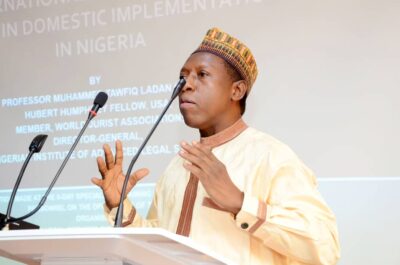
Professor Muhammed Tawfiq Ladan has called for accelerated domestication of international humanitarian law treaties, stronger prosecution mechanisms and improved protection for civilians and internally displaced persons, as Nigeria reviews a decade of legal and institutional interventions.
Ladan, Deputy Chairman of the National International Humanitarian Law Implementation Committee, made the recommendations in a comprehensive status report dated October 8, 2026, addressed to the Committee’s Chairman, the Solicitor-General of the Federation and Permanent Secretary, Federal Ministry of Justice, Abuja.
Covering the period from 2015 to October 2026, the report examines Nigeria’s legislative, policy, regulatory, institutional, administrative, educational and capacity-building measures for implementing International Humanitarian Law (IHL), International Criminal Law (ICL) and forced displacement treaties.
It identifies progress in legislation, counter-terrorism prosecutions, military training and institutional coordination, while highlighting continuing gaps in treaty domestication, operational compliance and accountability.
The report places these developments against the backdrop of the Boko Haram insurgency, Islamic State West Africa Province activities, cross-border banditry and farmer-herder conflicts, which have increased the need to integrate civilian protection and legal accountability into security operations.
Treaty Domestication and Protection for Displaced Persons
A central concern in the report is the gap between Nigeria’s international treaty commitments and their enforcement within the country.
It explains that Section 12(1) of the 1999 Constitution requires legislative enactment before an international treaty can have the force of law domestically.
According to the report, President Bola Ahmed Tinubu signed the Kampala Convention Domestication and Enforcement Act in March 2026, incorporating the African Union Convention for the Protection and Assistance of Internally Displaced Persons into Nigeria’s domestic legal framework.
The report identifies Deputy Speaker Benjamin Kalu as the sponsor of the legislation, alongside six other lawmakers.
It describes the legislation as a transition from emergency-driven interventions towards a framework based on the rights of displaced persons, including protection against arbitrary displacement, recognition of civil and socioeconomic rights, and improved coordination among responsible agencies.
The report also identifies the proposed Geneva Conventions and Additional Protocols (Domestication) Bill, 2026, and the Rome Statute of the International Criminal Court (Enforcement) Bill, 2026, as important measures for addressing outstanding enforcement gaps.
Its analysis presents the bills as a means of strengthening domestic accountability for international crimes and improving protection during counter-terrorism and counter-insurgency operations.
Domestic Prosecutions and Cooperation With the ICC
The report highlights the principle of complementarity, under which national authorities bear primary responsibility for investigating and prosecuting crimes within the jurisdiction of the International Criminal Court.
It records a March 2026 Memorandum of Understanding between Nigeria and the ICC Office of the Prosecutor, describing the arrangement as a framework for strengthening domestic accountability through technical exchanges, evidence-gathering benchmarks and monitoring of prosecution efforts.
According to the report, the absence of full domestication of the Rome Statute has encouraged prosecutors to rely on the Terrorism (Prevention and Prohibition) Act, 2022, to prosecute conduct associated with serious conflict-related offences.
On prosecution outcomes, the report states that Nigeria’s Mass Trial Programme secured 1,721 cumulative convictions from its commencement in October 2017 to mid-2026.
It records 366 convictions during the first three phases, 490 during phases four to eight, and 865 during phases nine and ten.
For the April 2026 Abuja sittings, the report states that four judges handled 508 cases over four days, resulting in 386 convictions, eight discharges, two acquittals and 112 adjournments.
It also records 888 discharges or acquittals between 2017 and mid-2024, underscoring the importance of reliable evidence, fair hearing and safeguards against arbitrary detention.
Command Responsibility and Civilian Protection
The report emphasises the responsibility of military commanders to prevent violations by personnel under their effective command and control.
Its analysis explains that responsibility may arise where a commander knew, or should have known in the circumstances, that personnel were committing or preparing to commit crimes and failed to take necessary and reasonable preventive or corrective measures.
It also addresses the limits of reliance on superior orders, particularly where instructions involve manifestly unlawful conduct, such as executing captured persons or attacking civilians indiscriminately.
On operational compliance, the report highlights rules of engagement, legal advice during military operations, target verification and safeguards governing detention and the treatment of captured persons.
It identifies protection of civilians, schools, farmland, water infrastructure and other objects indispensable to civilian survival as priorities in conflict-affected communities.
The report further examines the relationship between constitutional immunity under Section 308 and accountability under the Rome Statute. It distinguishes domestic restrictions on proceedings against specified serving executive officeholders from the international framework governing official capacity.
Rehabilitation, Oversight and Access to Justice
The report identifies the National Counter Terrorism Centre, Operation Safe Corridor and the National Human Rights Commission as important components of Nigeria’s institutional response.
It describes Operation Safe Corridor as a rehabilitation and reintegration programme for low-risk former combatants, combining vocational training, psychological care, civic education and legal screening.
According to the report, more than 3,000 former combatants had graduated from the programme by October 2026.
It stresses that screening should identify persons linked to serious war crimes for referral to prosecution rather than rehabilitation-based release.
The report also highlights human rights monitoring, complaints mechanisms, judicial review of military disciplinary decisions and remedies for wrongful detention as essential safeguards.
Education and Professional Training
Ladan’s report identifies sustained education as necessary to translate legal commitments into operational practice.
It highlights the Nigerian Universities and International Committee of the Red Cross seminar series, collaboration with the Nigerian Institute of Advanced Legal Studies, and the incorporation of humanitarian law into university and military education.
Institutions examined include the Nigerian Defence Academy, the Military Police College in Zaria and the National Defence College.
The report also identifies military law workshops and specialist training in investigation, forensic evidence, detention management and rules of engagement as important tools for improving compliance.
Recommendations for Government, Military and Judiciary
To address outstanding gaps, the report recommends an inter-ministerial legislative taskforce to accelerate work on the Additional Protocols and Rome Statute domestication proposals.
It also proposes a permanent Complementarity Secretariat within the Federal Ministry of Justice to coordinate reporting and implementation of Nigeria’s cooperation framework with the ICC.
Other recommendations include:
- Establishing a specialised International Crimes Unit within the Federal Ministry of Justice.
- Increasing funding and forensic capacity for the Mass Trial Programme.
- Embedding trained military legal advisers in operational command rooms.
- Making scenario-based instruction on command responsibility and humanitarian law a mandatory, assessed component of military training.
- Translating operational rules of engagement into Hausa, Kanuri and Fulfulde.
- Establishing a National Centre for IHL Studies in collaboration with the National Universities Commission.
- Designating specialised judicial desks at the Federal High Court for international crimes proceedings.
The report concludes that Nigeria has made substantial institutional and legislative efforts, but that effective implementation requires sustained coordination, credible investigations, fair trials and stronger protection for conflict-affected populations.
It maintains that operational success must coexist with respect for human rights and international humanitarian law.
Source: Comprehensive status report prepared by Professor Muhammed Tawfiq Ladan, Deputy Chairman, National IHL Implementation Committee, dated October 8, 2026.
Related news

behind Games Village, Abuja
5A, CGH, Games Village, Abuja