


“Perhaps You Have Come to the Kingdom for Such a Time as This.”
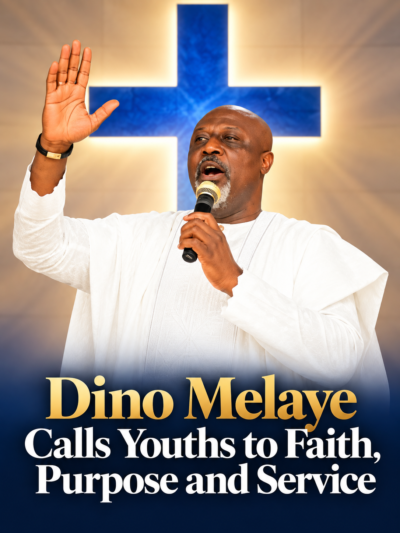
Former Senator representing Kogi West, Dino Daniel Melaye, has called on Nigerian youths to recognize their present season as one of purpose, responsibility, and service, urging them not to waste the strength, opportunities, and gifts entrusted to them.
In a deeply faith-centered address on leadership, youth, and national responsibility, Melaye drew extensively from Scripture, using the lives of Esther, Daniel, Jeremiah, David, and Timothy to illustrate his message that young people must not allow fear, age, or circumstances to prevent them from fulfilling their purpose.
At the heart of his message was a question:
“What is a voice for if it is never allowed to become power?”
For Melaye, however, power was not presented merely as political authority but as the capacity to use one’s voice, convictions, knowledge, and position in the service of others.
He later returned to the question and explained:
“What is voice for? It is not to become power, if not to become power that serves.”
He said he was leaving that question with the young people before him “not as rhetoric, but an assignment.”
‘Perhaps You Have Come for Such a Time as This’
Melaye anchored a substantial part of his message on the biblical account of Queen Esther.
According to him, Esther found herself in a position she did not plan for, at a moment that demanded courage and responsibility.
“Mordecai did not comfort Esther, he confronted her,” he said.
He recalled the words of Esther 4:14:
“Who knoweth whether thou art come to kingdom for such a time as this.”
Melaye explained that Esther’s position carried responsibility and that her silence would not prevent events from unfolding but could determine whether she would play a part in bringing about change.
He applied the same principle to young Nigerians.
“You were not born into this nation at this hour by accident. Like Esther, you have been positioned.”
He added:
“The only question left is whether you will rise to it or let the moment pass while someone else answers the call that was addressed to you.”
His charge was simple:
“Who knows, perhaps you have come to the kingdom for such a time as this.”
‘Youth Is Not a Waiting Room’
Melaye rejected the idea that young people must remain inactive until a later stage of life before they can make meaningful contributions.
He described youth as a period of commissioning rather than postponement.
“Youth is not a waiting room. It is a commissioning.”
Drawing from Scripture, he referred to Jeremiah, who initially considered himself too young for the assignment before him.
Melaye recalled God’s response:
“Say not, I am a child.”
He also pointed to David, Daniel, and Timothy as examples of young people entrusted with responsibility.
“David was a boy with a sling when he did what trained soldiers would not,” he said.
“Daniel was a teenager in exile when he refused to be shaped by a system that wanted to erase his convictions.”
Referring to Paul’s instruction to Timothy, he reminded the audience:
“Let no man despise thy youth.”
But Melaye emphasised that the passage did not merely offer encouragement. It also imposed responsibility.
“Be an example, not a spectator,” he said, referring to the biblical demand for young believers to be examples in words, conduct, love, faith, and purity.
‘Do Not Waste This Age’
Melaye further encouraged young people to appreciate the unique strength and dynamism of their youthful years.
He referred to the earthly ministry of Jesus Christ, saying:
“Our Lord Jesus Christ lived on earth for 33 years.”
He recalled Christ’s words on the cross:
“It is finished.”
Melaye said the lesson for young people was not merely about age, but about completing one’s assignment faithfully.
“There is a dynamism that belongs to the youth, a clarity and a fire that should never be wasted on distraction, dependency or delay,” he said.
His admonition was direct:
“This is your age of building. Do not waste it.”
He also drew examples from history and his own life to demonstrate that meaningful service need not wait until old age.
“I am not telling you my story to impress you,” he said.
“I am using my own life plainly to tell you that you can do it.”
‘Voice Without Discipline Is Noise’
Melaye also cautioned that having a voice does not automatically translate into meaningful influence.
“Voice without discipline is noise. Voice is easy. Everyone has one.”
He challenged young people to move beyond reaction and outrage into knowledge, preparation and responsibility.
According to him, a voice must first be formed by understanding before it can carry weight.
He warned against:
“Outrage without study, opinion without responsibility, hashtags without the harder, slower work of actually understanding the systems we are angry at.”
He said lasting change requires people who are willing to undertake the less visible work of preparation.
“It changes because someone did the unglamorous work of showing up, learning the law, understanding procedure, building the case, and staying.”
Melaye therefore urged young Nigerians not simply to speak loudly but to become knowledgeable, disciplined and competent.
Courage Must Walk With Wisdom
Again drawing from Esther, Melaye said courage alone was insufficient.
“Esther did not just have courage, she had strategy,” he said.
“She did not walk into the king’s presence recklessly; she prepared. She positioned herself, she chose her moment.”
He then delivered one of the strongest admonitions of his message:
“Courage without wisdom gets you killed. Courage with wisdom changes nations.”
Melaye said a meaningful voice must therefore be guided by something deeper.
“Let your voice be disciplined by knowledge, sanctified by prayer, and directed by purpose.”
Integrity Must Survive the Test of Power
Another major theme of Melaye’s message was integrity.
He argued that holding responsibility should not require a person to abandon deeply held principles.
“You can hold power and hold your principle at the same time.”
He said integrity becomes particularly important when a person encounters pressure.
“A principle that has never been tested has not yet been proven,” he said.
Drawing from his personal experiences in public life, Melaye said he had encountered opposition, court cases and intimidation but had made an earlier decision about the values he would not exchange for personal comfort.
“I refused to let go of my principles and my integrity, not because it was easy, but because I had already decided long before the pressure came what I was, and was not willing to trade for comfort.”
He consequently warned young people against corruption and complicity in wrongdoing.
“You cannot move from voice to power when you are corrupt. You cannot move from voice to power when you are aiding corruption.”
Daniel in Babylon: ‘That Is the Model’
Melaye returned repeatedly to the biblical figure of Daniel as an illustration of how believers could retain their convictions even within difficult environments.
“Daniel did not leave his integrity at the floor of the Babylonian government to fit in. He brought his conviction into a hostile system and outlasted it.”
He described that as a model for Christians who find themselves in positions of public responsibility.
“That is the model.”
According to him, faith should not exist only within the walls of the church.
He called for a Christianity that walks into the public square carrying the same values it professes in the sanctuary.
‘Carry Your Faith Into Public Life’
Melaye strongly encouraged Christians not to separate their faith from their conduct in public life.
“Carry your faith into public life without apology.”
He repeated the statement for emphasis.
Recalling his time in the Senate, Melaye said he once stood on the floor and sang the hymn “To God Be the Glory.”
He said his decision was rooted in his conviction that a Christian should not become ashamed of the Gospel simply because he occupies public office.
Quoting Scripture, he said:
“It is the power of God unto salvation.”
He also recalled the biblical teaching that God has not given believers a spirit of fear or timidity.
His wider argument was that public responsibility should not erase spiritual identity.
From Dependency to Responsibility
Melaye also warned against a form of passivity which, according to him, can sometimes be mistaken for patience.
“Political dependency is not humility, it is abdication.”
Beyond politics itself, his message centred on the responsibility to use what one already possesses.
Drawing from Christ’s parable of the talents in Matthew 25, Melaye said the servant who buried what had been entrusted to him was not commended for waiting.
“Faithfulness was expected with what he already had,” he said.
He told the young people:
“You already have what you need to begin — your votes, your voice, your community, your gifts, your witness.”
He urged them to take responsibility within the spaces already available to them — their communities, professions, churches, institutions and other structures of society.
‘Occupy Institutions, Not Just Timelines’
Melaye encouraged young people to move beyond commentary and become involved in organisations where meaningful decisions are made.
“Occupy institutions, not just timelines.”
He urged them to participate in professional bodies, community associations, church boards and committees, and other structures through which society functions.
He said:
“Power is inherited by those who are present in the room when decisions are made. Not by those who are loudest outside the room.”
Where young people choose to participate in politics, he also urged them to do so responsibly by voting, understanding the Constitution, joining legitimate structures, and preparing themselves adequately for leadership.
But he insisted that preparation must precede position.
Build Competence in Something Real
Melaye urged young Nigerians to acquire knowledge and practical competence.
“Build competence in something real.”
He mentioned law, health, finance, engineering, agriculture and technology among fields in which young people should develop themselves.
His message was that leadership must be accompanied by capacity.
He urged the emerging generation to prepare itself so that when opportunities for responsibility arrive, it will possess more than anger about what previous generations have done.
He said young people must inherit responsibility:
“With capacity, not only with grievance.”
Faith, Conviction, and Competence
Melaye ultimately placed three qualities at the centre of his message: faith, conviction and competence.
He challenged young people to carry those qualities into every legitimate area of life.
“Nigeria does not need another generation that talks about change and waits for permission to make it,” he said.
“It needs a generation that counted the cost, got on its knees, and then got up and gone to work.”
He envisioned young Nigerians serving:
“In courtrooms and classrooms, in wards and in the National Assembly, in churches and in civil life, carrying both conviction and competence.”
‘Picture the Future You Want to Feature In’
As he approached the conclusion of his address, Melaye challenged the audience to develop a clear vision of the future they wanted to help build.
“You will only picture a future you want to feature in.”
He deliberately played on the words “picture,” “future,” and “feature,” asking members of the audience to see themselves as participants in the future rather than distant observers of it.
“I will picture my future that I want to feature in.”
He described this as:
“The power of dream.”
His message was that genuine faith should produce responsibility, preparation, and action.
‘We Shall Overcome’
Melaye concluded on a hopeful and prayerful note, inviting those who identified with his message to stand.
He reflected on the role of faith and hope in struggles for justice and social transformation before leading the gathering in the historic song:
“We shall overcome someday.”
And again:
“Deep in my heart, I do believe. We shall overcome someday.”
The closing moment reflected the central message running through his address: that faith should not produce passivity, and that young people must combine spiritual conviction with integrity, knowledge, service, and courage.
For Melaye, the call was ultimately not merely about occupying positions.
It was about becoming prepared men and women whose faith and character could survive responsibility when the opportunity to serve eventually comes.
- Related Story: Nigeria’s Youth Take the Lead: Building a New Culture of Civic Power and Public Accountability—it closely complements Melaye’s message on youth responsibility, leadership, civic participation, and moving beyond passive commentary. Nigerian Law Updates
- Another Related Story: Leadership Must Be Based on Competence, Not Tokenism—Aare Olumuyiwa Akinboro, SAN, Challenges Young Lawyers—particularly relevant to Melaye’s emphasis on competence, preparation, and purposeful leadership.