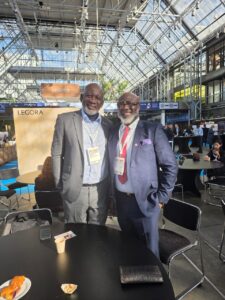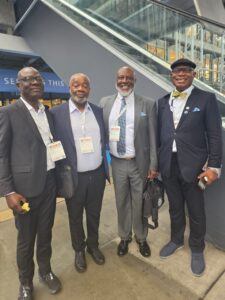


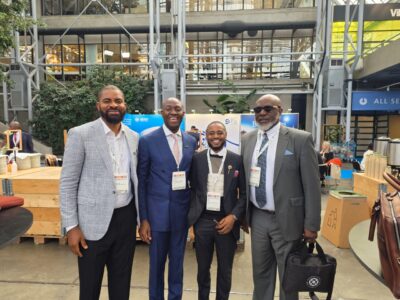
COPENHAGEN, DENMARK — Senator Dino Melaye, Esq., has challenged international legal and policy experts at the ongoing International Bar Association Annual Conference 2026 in Copenhagen on two issues increasingly defining global law and public policy, the ethical consequences of artificial intelligence and Europe’s capacity to sustain Ukraine against Russia if United States support weakens.
The interventions came as the IBA’s annual gathering, holding from 4 to 9 October 2026, devotes substantial attention to artificial intelligence, professional ethics, international security, sanctions, accountability and the changing international legal order.
Melaye’s first intervention went directly to the growing discomfort surrounding the rapid adoption of artificial intelligence.
Rather than questioning whether AI is useful, he challenged the panel to explain how its benefits could be reconciled with the risks already confronting governments, lawyers, businesses and ordinary citizens.
“I just have some ethical concerns, and I hope that by the time I’m done, if I’m satisfied with the response of the panel, then I will be able to tell if I’m wasting my time with AI or not,” Melaye said.
He then identified the areas troubling him.
“These ethical issues and concerns are the following: the issue of job displacement, the issue of privacy, the issue of bias, explainability, accountability and even deepfakes.”
Melaye also raised misinformation, exploitation of intellectual property, the erosion of social connection and the difficulty of maintaining ethical standards when businesses and countries are simultaneously competing for technological advantage.
“With misinformation, exploitation of intellectual property, loss of social connection and balancing ethics with competition — with all these ethical issues, I really want to be educated. How do you combat these ethical issues?”
The questions were particularly relevant to the Copenhagen agenda.
One IBA session this week on Diversity and Inclusion and Artificial Intelligence expressly identified algorithmic bias, discrimination, opacity in AI systems, unequal access to technology, data-privacy concerns and job displacement among the risks that must be confronted as AI becomes embedded in professional and social life. The programme also considers how AI can be used positively to identify bias and improve accessibility.
Another IBA session on Artificial Intelligence and Professional Ethics is examining how professional rules for lawyers may have to evolve as AI becomes commonplace, with the IBA’s Bar Issues Commission working toward further guidance for Bar associations and possible commentary on professional conduct principles.
The issue of responsibility, central to Melaye’s question also featured directly in Wednesday’s programme under the provocative title “Mind of the machine: who pays when AI goes wrong?”
That discussion examines how traditional legal principles of fault, duty and causation should apply where harm is caused by AI, and how liability should be distributed among developers, users and third parties.
The IBA is equally confronting the implications for legal practice itself. Its Wednesday session on the AI-driven law firm considers data protection, intellectual-property ownership and professional responsibility as firms increasingly integrate artificial intelligence into their operations.
For Melaye, however, the problem extends beyond professional efficiency.
His reference to deepfakes raised the question of what happens when increasingly powerful AI systems make it possible to manufacture convincing images, voices and videos that ordinary citizens may struggle to distinguish from authentic material.
He cited a study during his intervention while questioning the scale of AI-generated deepfake material. The specific percentage mentioned by Melaye could not independently be verified by LegalLinkz from the sources reviewed, but the underlying danger he raised is well documented: Microsoft itself has warned that advances in AI-generated synthetic media and deepfakes can strengthen disinformation and influence operations.
That distinction is important. The legal challenge is no longer simply whether content is false; increasingly, courts, regulators and the public must determine whether apparently authentic digital evidence was ever real at all.
Melaye Turns to Ukraine: ‘Can Europe Contain This War Without America?’
In a separate intervention on Russia’s war against Ukraine and the future of European security, Melaye questioned whether the measures deployed by Europe since Russia’s full-scale invasion have been sufficient.
Russia launched its full-scale invasion of Ukraine on 24 February 2022. Four years later, the European Union continues to impose sanctions while simultaneously providing financial, humanitarian and military support to Kyiv. In July 2026, the EU adopted its 21st sanctions package, extending restrictions across Russian energy, finance, crypto services and the so-called shadow fleet.
Melaye’s concern was that despite successive rounds of sanctions, the conflict continues.
He asked whether Europe could sustain the confrontation if Washington became less reliable as a strategic partner.
“The question now is: can the EU contain this Russian war without America?”
He then pressed the point further:
“And if yes, is there a need for an upscale — a massive, colossal upscale? And what will this upscale be by the EU?”
The question cuts to one of the most consequential strategic debates confronting Europe.
The EU says it has mobilised more than €227 billion in financial, economic, military and humanitarian assistance to Ukraine, while European leaders have agreed to provide an additional €90 billion for 2026–2027, including substantial defence support.
NATO’s own position also shows Europe carrying a larger share of the burden. At its 2026 Ankara Summit, NATO said European Allies and Canada now finance the vast majority of security assistance to Ukraine, while Allies collectively pledged €70 billion in military equipment, assistance and training for 2026.
But the response to Melaye’s question underscored the limits of escalation.
The panel response stressed that European and NATO governments have consistently tried to balance stronger support for Ukraine against the danger that direct military intervention could widen the conflict into a much larger war.
Ukraine is not currently covered by NATO’s collective-defence guarantee in the way a NATO member is.
The response therefore drew an important distinction between providing Ukraine with weapons, money, training and political backing and directly entering the conflict as a combatant.
The speaker acknowledged that sanctions and asset freezes had not ended Russian aggression and suggested that European countries would have to do more to strengthen Ukraine.
But the panel cautioned that direct NATO entry into the war would carry consequences far beyond Ukraine.
That concern sits squarely within the broader Copenhagen programme.
On Wednesday, the IBA is hosting a dedicated “Conversation on Ukraine” with Ukraine’s Ambassador to the Netherlands and former Prosecutor General Andriy Kostin, Ambassador Anton Korynevych, and Danish Foreign Ministry official Thomas Lund-Sørensen, moderated by IBA Executive Director Dr Mark Ellis.
The conference is also examining sanctions as legal instruments, including whether they genuinely advance accountability or risk producing unintended consequences, as well as the broader weaponisation of trade, sanctions and export controls in contemporary geopolitical conflict.
The Ukraine question has become particularly acute because sanctions were intended to reduce Russia’s capacity to finance and sustain its military campaign.
The EU has progressively tightened those measures, targeting energy revenues, financial institutions, military-industrial networks, technology and vessels associated with Russia’s shadow fleet. It has also imposed measures involving Belarus because of what the EU describes as its role in enabling Russia’s war effort.
Yet the war continues.
That was ultimately the tension behind Melaye’s intervention.
If sanctions alone have not brought the conflict to an end, what comes next — stronger sanctions, substantially greater European military support for Ukraine, larger European defence budgets, deeper NATO coordination, or some combination of all four?
And at what point does increased assistance create an unacceptable risk of direct confrontation between NATO and Russia?
Those questions do not produce easy answers, but they explain why Melaye’s intervention resonated with two of the defining themes running through Copenhagen: how institutions manage technologies whose consequences they cannot fully predict, and how the international legal order responds to threats it has so far been unable to end.
For lawyers, both debates eventually return to responsibility.
When AI causes harm, who answers for it?
When sanctions fail to stop aggression, what lawful tools remain available?
And when technological innovation or geopolitical competition moves faster than existing rules, is law merely reacting — or is it still capable of shaping what comes next?
In Copenhagen, Senator Dino Melaye, Esq., put those questions directly before the people expected to help provide the answers.
Related Stories
READ MORE: IBA Copenhagen 2026 Opens With Nigerian Lawyers in Key Roles
READ MORE: NBA Port Harcourt Chairman Urges Lawyers to Embrace AI
READ MORE: AI Copyright, Fair Use: OpenAI, New York Times
Photos: