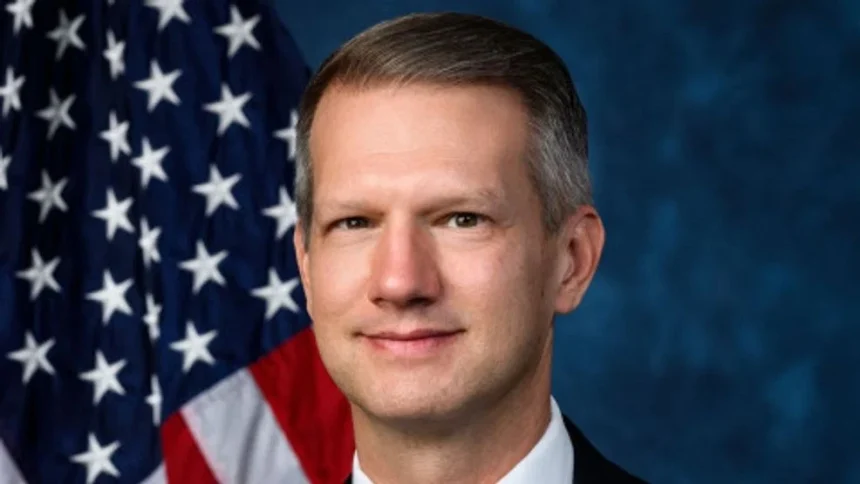
United States Congressman Riley Moore has described his recent visit to Nigeria as “distressing,” citing what he characterised as deeply troubling encounters with victims of violent attacks in the country’s Middle Belt region.
Moore, a lawmaker from West Virginia, led a five-member United States congressional delegation on a fact-finding mission to Nigeria, during which the team spent several days in Benue State engaging with internally displaced persons (IDPs), survivors of attacks, religious leaders, traditional rulers, and affected local communities.
The delegation also held high-level meetings in Abuja with Nigeria’s National Security Adviser, Mallam Nuhu Ribadu, and the Attorney General of the Federation and Minister of Justice, Mr. Lateef Fagbemi, SAN, as part of efforts to assess the country’s security challenges and ongoing government responses.
Speaking during an interview with Fox News, excerpts of which he shared on his official X (formerly Twitter) account on Saturday, Congressman Moore recounted what he described as harrowing personal testimonies from victims of violence.

According to him, one woman narrated how she watched all five of her children killed during an attack, while another woman he met in an IDP camp reportedly lost her husband and two daughters in a separate incident.
“I met another woman in an internally displaced persons camp who lost her husband and her two daughters,” Moore said, adding allegations of extreme brutality during the attack. He noted that the woman survived and now lives in an IDP camp alongside other displaced persons.
Moore further alleged that the violence in parts of Nigeria’s Middle Belt amounted to what he described as a “systematic genocidal campaign” against Christian communities in the region.
“There is a systematic genocidal campaign by Fulani Muslim radicals in the Middle Belt of this country to push Christians off their ancestral land,” the Congressman claimed, reiterating that the attacks appeared targeted and persistent.
Despite the disturbing accounts, Moore said the delegation’s engagement with Nigerian authorities was constructive, expressing cautious optimism about the possibility of deeper security cooperation between Nigeria and the United States.

“There are positive things coming out of that government that I think will put us on a path toward a strategic security framework and a cooperative agreement to start addressing these issues,” he stated.
The US lawmaker also disclosed that the delegation plans to brief former US President Donald Trump on their findings before the end of the month, stressing that the protection of Christian communities remains a priority.
“First and foremost, my concern, and the President’s concern, is for these Christians, our brothers and sisters who are being slaughtered,” Moore said.
He acknowledged that Nigeria’s security challenges extend beyond the Middle Belt, pointing to the continued threat posed by terrorist groups such as Boko Haram and the Islamic State West Africa Province (ISWAP) in the North East.
Moore described Nigeria’s security crisis as “two-tiered,” involving both terrorism and what he termed religious persecution.
“The problem is two-tier, and we have to address this Christian persecution and genocide that is happening in the Middle Belt of this country,” he concluded.
The Nigerian government has repeatedly stated that it is committed to addressing insecurity nationwide, insisting that criminal violence in affected regions is not driven by religious or ethnic policy but by complex security, economic, and social factors.
Read More:
INDIA — Bombay High Court Rejects Mosque’s Plea to Use Loudspeaker for Prayers