

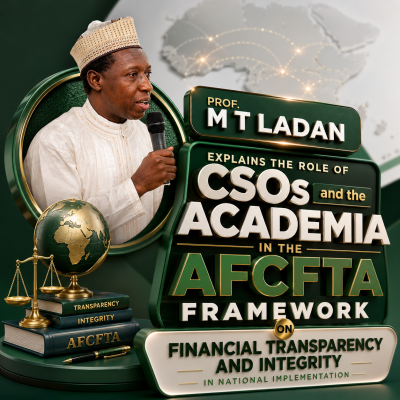
Renowned legal scholar and trade policy expert, Prof. M. T. Ladan, has underscored the indispensable role of Civil Society Organizations (CSOs) and academia in promoting financial transparency, integrity, and accountability in the implementation of the African Continental Free Trade Area (AfCFTA).
Speaking on the AfCFTA framework, Prof. Ladan explained that achieving transparency across Africa’s single market requires harmonized customs digitization, cross-border Beneficial Ownership (BO) disclosures, transparent tariff administration, and strong regional anti-corruption mechanisms.
He identified CSOs and academic institutions as strategic partners in ensuring that AfCFTA implementation remains transparent, inclusive, and evidence-driven.
According to him, digital integration of customs systems, tariff schedules, and trade information portals is essential to preventing bureaucratic manipulation and strengthening public confidence in cross-border trade.
Prof. Ladan further highlighted the importance of the Pan-African Payments and Settlement System (PAPSS), describing it as a transformative financial infrastructure that enhances transparency in cross-border transactions by reducing dependence on third-party currencies while creating verifiable audit trails.
On combating illicit financial flows, he advocated stronger regional anti-graft mechanisms, including the integration of national Beneficial Ownership registries into continental databases to improve financial accountability and prevent asset misallocation.
Addressing the role of Civil Society Organizations, Prof. Ladan noted that CSOs serve as independent watchdogs by promoting accountability, advocating compliance with trade rules, exposing corruption, and ensuring that governments and private sector actors uphold the principles of the AfCFTA.
He also emphasized their responsibility in championing the inclusion of women, youth, small and medium-sized enterprises (SMEs), and other marginalized groups, ensuring that the economic benefits of free trade extend to grassroots communities. He further called for stronger whistleblower protection frameworks to encourage the reporting of illicit financial practices without fear of retaliation.
Turning to academia, Prof. Ladan described universities and research institutions as critical drivers of policy development and implementation. He explained that scholars provide evidence-based research, conduct legal readiness assessments, identify gaps between domestic legislation and AfCFTA obligations, and generate practical recommendations for policymakers.
He added that academic institutions also play a vital role in capacity building by developing training programmes for trade professionals, border officials, legal practitioners, and other stakeholders, thereby strengthening compliance with AfCFTA transparency and integrity standards.
Prof. Ladan concluded that sustainable implementation of the AfCFTA depends on effective collaboration among governments, civil society, academia, and the private sector to build a transparent, accountable, and inclusive continental trading system capable of delivering long-term economic growth across Africa.
Read More: