

The video coming out of Benue State raises a serious question that goes beyond Peter Obi, Governor Hyacinth Alia or the politics of 2027.
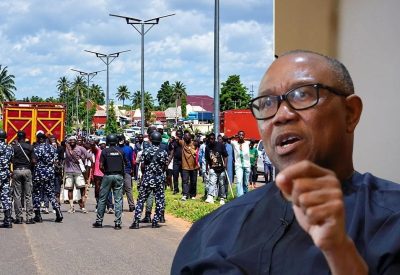
Peter Obi, presidential candidate of the Nigeria Democratic Congress (NDC), travelled to Benue State to visit and sympathise with families affected by the Yelewata killings.
His convoy was subsequently stopped by youths who barricaded the road, preventing him from proceeding to his destination.
The Benue State Government has denied responsibility and says it was not formally informed of Obi’s visit. Obi’s team, however, says the relevant security agencies were informed, while the Benue State Police Command reportedly confirmed that it was aware of the movement and had provided security.
So, there are two different questions here.
First: Was the Benue State Government properly notified?
That is a question of protocol and security coordination, and the competing accounts should be properly investigated.
But the second question is far more important:
WHO GAVE ANY PRIVATE GROUP OF YOUTHS THE LEGAL AUTHORITY TO BLOCK THE MOVEMENT OF A CITIZEN AND PRESIDENTIAL CANDIDATE ON A PUBLIC ROAD?
If the state government was genuinely unaware of the visit, the appropriate response should ordinarily have been through recognised security agencies; not unidentified persons taking over a public highway and physically preventing movement.
If there was a genuine security threat, where was the lawful security directive? Who authorised the roadblock? What was the legal basis for stopping the convoy?
And if nobody authorised it, who is going to be held responsible for the unlawful obstruction?
The Legal Authorities: Constitutional and Statutory Violations
- As legal practitioners, we must refrain from convicting any actor in the court of public opinion. While the evidence confirms the physical obstruction of Obi’s convoy, it does not yet establish who ordered or funded the blockade. However, the act itself constitutes a clear violation of Nigerian law, which I will state as follows:
Freedom of Movement (Section 41, 1999 Constitution as Amended):
Section 41(1) guarantees every citizen the right to move freely throughout Nigeria and reside in any part thereof. In Inspector General of Police v. All Nigeria Peoples Party (2007) 18 NWLR (Pt. 1066) 457, the Court of Appeal affirmed that the right of citizens to move freely and assemble without unwarranted government or private interference is fundamental to a constitutional democracy. - Invalidity of Arbitrary State/Private Obstruction:
The Supreme Court in Director, SSS v. Agbakoba (1999) 3 NWLR (Pt. 595) 314 held that any restriction on a citizen’s constitutional right to movement must be strictly justified under the law (such as a valid court order or statutory criminal procedure). Private citizens or political thugs have no legal backing to restrict movement on public roads. - Criminality of Public Roadblock and Wrongful Restraint:
Under Section 226 of the Penal Code (applicable in Benue State) and Section 243 of the Criminal Code, setting up unauthorized roadblocks, obstructing public highways, and wrongfully restraining individuals constitute criminal offenses punishable by law. - The Illegal Usurpation of Public Order:
In ANPP v. IGP (supra), the court made it clear that police permits or government clearance are not statutory prerequisites for peaceful political assembly or movement. No state governor or local authority possesses the legal power to turn a federal highway into a private estate.
Democracy Cannot Survive Private Lawlessness
At this stage, the available facts confirm an illegal obstruction. They do not yet confirm whether government officials directed the act. That factual distinction matters.
However, political disagreements must never serve as a pretext for non-state actors to take the law into their own hands. Nigeria cannot sustain a constitutional democracy where political candidates, opposition leaders, or ordinary citizens can be physically blockaded by armed or organized groups acting with impunity.
The Benue incident demands a thorough, independent criminal investigation; not political rhetoric.
The Relevant Authorities Must Establish:
i. Who organized, mobilized, or financed the blockade?
ii. Was any government official or agent complicit?
iii. Were the Police and DSS properly notified, and what was their operational response?
iv. Was there any lawful security order restricting movement in that sector?
v. Why have the individuals captured on camera obstructing a public highway not been arrested and charged under the Penal Code?
Today, it is Peter Obi. Tomorrow, it could be a sitting governor, a senator, a journalist, or an ordinary Nigerian citizen traveling across state lines.
The rule of law is either absolute or non-existent; it cannot depend on political alignment. Politics must never become a license for lawlessness.
John Oluwasina Adewakun, Esq.
Immediate Past Secretary,
Nigerian Bar Association,
Gwagwalada Branch,
Legal Practitioner | Political Analyst
Read More:
Olawale Fapohunda, SAN, Congratulates AG

behind Games Village, Abuja
5A, CGH, Games Village, Abuja