One weekday afternoon at World Lilies Event Centre in Apata, Ibadan, nothing about the hall suggested controversy.
Thick curtains. A high table. Familiar faces from years of Bar conferences. The banner spoke the usual soft language: women, summit, Egbe Amofin Oodua. It felt like yet another family meeting of the profession, with everyone present.
Then came the moment now living on lawyers’ phones.
In a short video from the summit, Professor Foluke Dada addresses the gathering. In substance, she does two things: she announces that she has stepped down from the Nigerian Bar Association (NBA) presidential race. And she acknowledges Aare Olumuyiwa Akinboro, SAN, as the “sole aspirant” for the NBA 2026 General Election, expressly tying that position to Egbe Amofin Oodua’s 2025 AGM resolution in Abeokuta.
The applause in the room is polite, even warm.
Outside it, among lawyers from Delta to Lagos, that phrase “sole aspirant” hits a nerve: when did a zoned presidency become something an ethnic caucus can close up and present as a finished product?
The starting point is not Abeokuta or World Lilies. It is the NBA Constitution.
Since the 2015 reforms, the Constitution divides the Association into three geographical zones for the purpose of electing national officers. It provides that the offices of President and the three Vice Presidents and General Secretary “shall rotate among the three zones,” and that elections into those offices “shall be by universal suffrage and electronic voting.”
The Second Schedule then spells out which states belong to each zone. The Western Zone is defined as Delta, Edo, Ekiti, Lagos, Ogun, Ondo, Osun and Oyo.
“West” in NBA law is not a poetic shorthand for “Yorubaland.” It is a constitutional construct that puts the Yoruba-majority states and the Mid-West states of Edo and Delta under the same electoral umbrella.
The same Schedule adds an important rider: when a position is zoned to a geographical zone, it “shall be rotated and held in turn by the different groups and/or sections in the geographical zone.”
That language came out of a hard history: years when the Bar was deeply fractured, and some regions felt locked out of national leadership. Zoning was supposed to share opportunities, calm nerves, and give every part of the country a stake in the presidency.
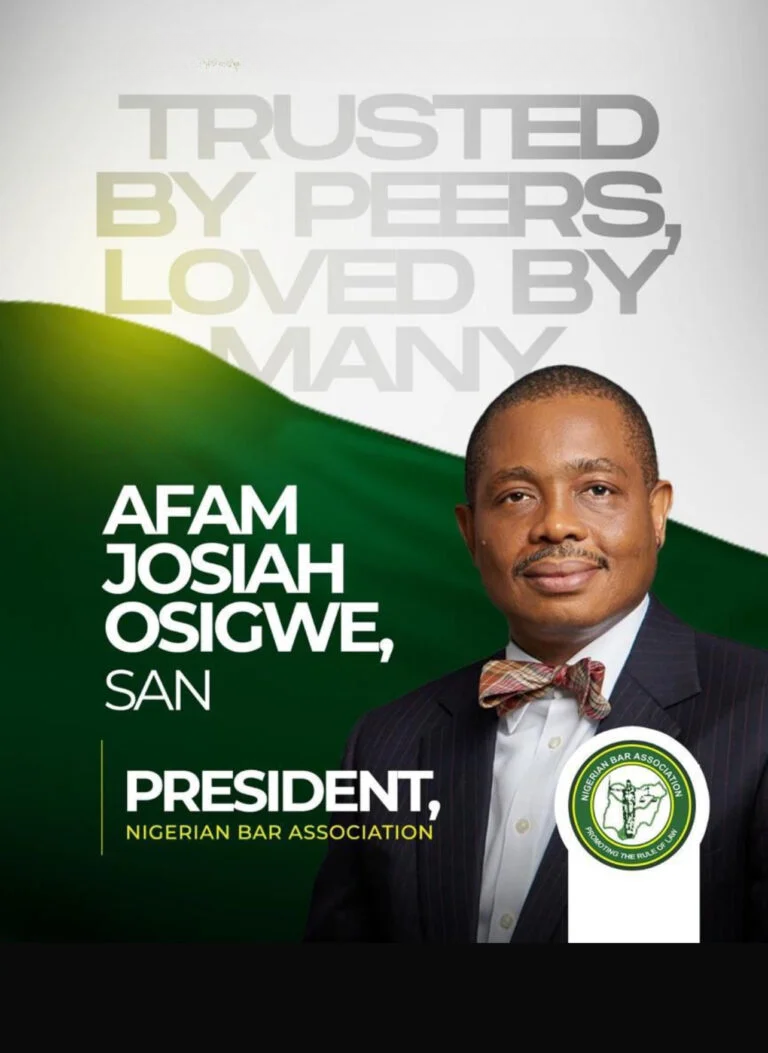
In practice, rotation has largely followed this logic. The West produced Olumide Akpata in 2020. The East produced Paul Usoro before him and Afam Osigwe after the Constitution was tightened. The North has had its turns. The expectation now built into public commentary is simple: 2026 is the Western Zone’s turn.
Within the Western Zone, another bargain has been struck. In August 2025, the Mid-West Bar Forum, representing Edo and Delta, wrote formally to the NBA President to say it had “yielded and conceded” the 2026 presidency to the South-West sub-zone, and directed its own aspirants to stand down.
So far, so good: zoning, micro-zoning, and a difficult compromise. A sense that, this time, the candidate should come from the South-West.
But there is a difference between saying “it’s your section’s turn” and saying “and we have already chosen the only person you are allowed to take seriously.”
On 7 August 2025 at its AGM in Abeokuta, the Yoruba lawyers’ forum, Egbe Amofin O’ odua, endorsed Aare Olumuyiwa Akinboro, SAN, as its preferred man for 2026.
According to detailed reports of the meeting, a special committee chaired by Toyin Bashorun, SAN, was set up to evaluate all South-West aspirants who had declared an interest in the presidency. Using criteria such as professional experience, national appeal, composure, and loyalty to Egbe ideals, the committee recommended Akinboro. The AGM adopted him as a “consensus candidate” and reaffirmed an earlier resolution to favour the Oyo/Osun axis, especially Osun, which has never produced an NBA President.
Crucially, the communiqué “appealed” to other South-West aspirants, including Lateef Omoyemi Akangbe, SAN, Prof. Foluke Dada-Lawanson and Mrs Oyinkansola Badejo-Okusanya, to step down “in the spirit of unity.”
Within a caucus, none of these are unusual. Blocs endorse. Forums line up behind their own. No law stops Egbe Amofin, or any regional group, from saying, “this is our choice.”
The problem began when the consensus turned into closure.
At World Lilies, Prof. Dada did not simply say, “I support Akinboro.” She told a room of Yoruba women lawyers that she had stepped down and that, in line with Egbe’s AGM resolution, Akinboro is the “sole aspirant” for the NBA 2026 elections.
That is no longer an internal endorsement. It is a claim about the field itself.
The Constitution does not give Egbe or any forum the power to turn a zonal slot into a private crown. The only body with the mandate to decide who appears on the ballot is the NBA’s Elections Committee (ECNBA), acting under the Constitution and its schedules.
The phrase sole aspirant is therefore not just loose talk. It sits on the fault line between influence and usurpation.
If this were simply a Yoruba house matter, perhaps the rest of the West would have shrugged and moved on. But it is not.
The same Mid-West Bar Forum that ceded its turn for 2026 has since felt obliged to clarify the terms of that concession. In a strongly worded response to Egbe’s follow-up letter, the Forum thanked Egbe for acknowledging the constitutional provisions on zoning and sub-zoning but drew a red line:
We are “unable to agree with you that any member of the Mid-West Bar Forum will dictate or impose” a candidate on its members.
In other words, we yielded the slot, not our freedom to think.
The Forum also reminded everyone that, as of the date of its clarification, “four candidates from the South-West” had indicated interest in the presidency and were still actively canvassing support nationwide. The reality on the ground, it suggested, did not match the story of a settled “sole” anything.
The letter is measured but firm. A group that has produced a president before, Olumide Akpata, is saying: we know what it means to have the turn, and we chose to step aside this time. However, we did not surrender our right, or anyone else’s, to see more than one face on the screen when e-voting opens.
All of this would sting less if it were not Foluke Dada at the centre of the World Lilies clip.
Over the years, Bar media have presented her as a Professor of Law, Dean at Caleb University, and former 2nd Vice President of the NBA (2018–2020), a woman with decades of standing in both academia and practice.
In the early noise around 2026, her name was floated as a plausible presidential contender from the Osun axis. Egbe itself made a point of stressing that Osun has never produced an NBA President in explaining its preference for the Oyo/Osun corridor.
Then came the Abeokuta AGM, with its gentle but very public “appeal” for her and others to step down from the race. Then came the World Lilies summit, where she herself tells a friendly room that she has done just that, and that the man the caucus chose is now the sole aspirant.
No one doubts her right to make political calculations. She might sincerely believe that Akinboro is the best person for the job. She might have weighed the odds and chosen a different office. That is her prerogative.
The question is, what do her words teach?
To the young woman in Lagos who watched that clip on a phone screen, what lands is simple: it is not the black-letter text of the Constitution that shapes your future; it is what a handful of men and women, gathered in Abeokuta and Ibadan, decide to permit.
The Bar likes to tell itself that it is different, a community of professionals committed to the rule of law. Here, though, the message is that when it comes to power, we behave like everyone else: tribes first, rules later.
Defenders of Egbe’s strategy respond with a familiar argument: without regional forums, zoning would be chaotic. Who will “manage” the provision that a zoned position should be “rotated and held in turn by the different groups and/or sections in the geographical zone,” they ask, if not those very forums?
It is a fair question. Regional bodies have played a role in lowering the temperature of elections, nudging aspirants to respect informal turns, and stopping the strongest zone from grabbing every opportunity.
However, there is a line between managing rotation and monopolising it.
The Constitution speaks of “groups and sections” inside a zone but does not define them. History fills in some of the blanks: Mid-West and South-West in the West, South-East and South-South in the East, and various northern blocs in the North.
These are broad internal regions. These are not secret cults. They are not ethnic unions with gate keys.
When a Yoruba forum speaks and behaves as though it can close the Western slot, and a senior figure repeats that framing on a public stage, it narrows the meaning of “group and section” down to something much smaller: a few hundred people in one network claiming to speak for thousands.
That is not the spirit of the clause. It is its capture.
Strip away the constitutional citations and the communiqués, and what remains is an uncomfortable mirror.
A professional body that disciplines others for ignoring written rules is flirting with the same behaviour itself. A Constitution that tried to move the Association beyond raw ethnic rivalry is being bent to justify a renewed form thereof. A mechanism designed to share power is used to seal it.
If young lawyers conclude that NBA elections are just a more educated version of ethnic politics, endorsements dressed up as destiny, and zoning reduced to “our turn, our person, full stop”, then the Association will lose the moral vocabulary it needs when it speaks about democracy in the wider country.
The same Bar that insists the state should not impose “sole administrators” in place of elected governors now watches one of its largest forums behave as though it can impose a “sole aspirant” on a zonal field.
The point is not whether Aare Akinboro is competent or likeable. The point is how he is being presented: as the inevitable endpoint of a process that many members neither saw nor consented to.
NBA elections will come and go. A President will emerge in 2026. Branches will revert to their usual work.
The answer to a simple question will not quietly reset.
When the presidency is zoned to the West and micro-zoned to the South-West, who owns that turn?
If the real answer is “a cultural forum that has already decided for everyone else”, then the NBA should stop pretending it is different from the politics it condemns.
It cannot preach constitutionalism in the country while practising coronation at home.
Thank you for reading. Sani Ammani is a retired poet, recovering writer, and collector of poignant stories. He writes from the ancient commercial city of Kano.
Read More: