
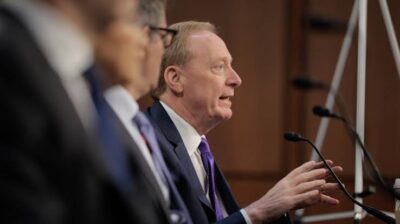
Microsoft President Brad Smith has called for stronger global regulation of artificial intelligence, arguing that existing legal controls have failed to keep pace with the speed and scale of AI development.
In an interview published today, Smith said ordinary consumer products are subject to clearer safety rules than some of the world’s most powerful AI systems.
He urged governments to develop a common regulatory framework that would require AI companies to notify authorities and affected persons when serious incidents occur, maintain emergency shutdown capabilities and report significant system failures.
The intervention comes as regulators across the United States, United Kingdom and European Union continue to debate how tightly AI should be controlled.
The EU has adopted a risk-based regulatory framework, while the United Kingdom has preferred a lighter, institution-led approach.
Smith pointed to Britain’s AI Security Institute as a potential model for pre-deployment testing, while also acknowledging that voluntary systems may not be enough in the long term. Reuters
For lawyers, the implications are substantial.
AI regulation is increasingly moving from ethics and professional guidance into questions of mandatory compliance, product liability, reporting duties and corporate accountability.
The emerging legal question is no longer whether AI should be regulated.
It is how far those rules should go, who should enforce them and what happens when a powerful system fails.
Related Stories
READ MORE: IBA Asks How Lawyers Stay Intelligent in AI Era
READ MORE: IBA: AI Alone Will Not Make Law Firms Stand Out

behind Games Village, Abuja
5A, CGH, Games Village, Abuja