

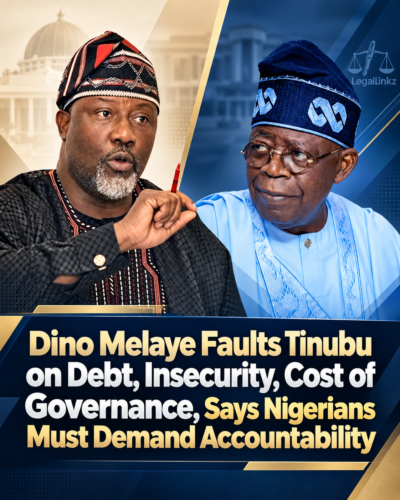
Former Senator Dino Melaye, a former member of the House of Representatives who represented Kogi West in the Senate and is currently a chieftain of the African Democratic Congress (ADC), has renewed his criticism of President Bola Ahmed Tinubu’s administration, questioning its borrowing, spending priorities, handling of insecurity and response to the economic hardship confronting Nigerians. Melaye has remained an outspoken opposition figure ahead of the 2027 general election. (Premium Times Nigeria)
In a lengthy address, Melaye argued that the most important question surrounding Nigeria’s expanding public debt was not simply how much had been borrowed, but what Nigerians could point to as the measurable benefit of that borrowing.
He accused the administration of increasing the country’s debt burden despite the removal of petrol subsidy and questioned why, in his view, ordinary Nigerians had not experienced a corresponding improvement in infrastructure, healthcare, education, security and living standards.
Melaye claimed Nigeria’s borrowing had moved close to ₦200 trillion under the Tinubu administration. Official figures are lower: the Debt Management Office reported Nigeria’s total public debt at ₦166.79 trillion as of June 30, 2026, up from ₦159.35 trillion in March. Of that figure, the Federal Government accounted for about ₦152.77 trillion, while states and the FCT accounted for the balance.
The former senator nevertheless maintained that Nigerians were entitled to demand a clear connection between increased indebtedness and improvements in their daily lives.
For Melaye, government borrowing should ultimately be assessed by what it produces.
His argument repeatedly returned to one question: what has Nigeria gained from the additional debt?
Melaye Questions Cost of Governance
Melaye also criticised spending associated with the Presidency, particularly foreign travel, presidential transportation and other high-value government expenditure.
He argued that such spending had become difficult to justify at a time when many Nigerians were struggling with food prices, healthcare costs and declining purchasing power.
There is documented evidence of substantial travel-related expenditure by the Presidency. An analysis of GovSpend records published earlier in 2026 showed that the Presidency spent at least ₦34.39 billion on foreign-exchange purchases connected with international travel and related obligations in 2024 and 2025, including ₦29.35 billion in 2024.
Melaye also referred to the acquisition of a new presidential aircraft. The Presidency confirmed in August 2024 that an Airbus A330 had been acquired to replace the 19-year-old Boeing 737 previously used by the President. Officials defended the replacement on safety and maintenance grounds, saying the newer aircraft would reduce long-term fuel and maintenance costs, although the government did not initially disclose the acquisition price.
The former senator’s broader argument was that leadership should demonstrate restraint when citizens themselves are repeatedly being asked to endure economic sacrifices.
‘Leadership Must Be by Example’
Melaye devoted considerable attention to the Federal Government’s decision to provide an independent solar-power system for the Presidential Villa.
Approximately ₦10 billion was allocated in the 2025 budget and another ₦7 billion in 2026 for the Villa’s solar mini-grid project. Government officials have defended the investment on cost-saving and energy-security grounds, citing the Presidential Villa’s reported electricity expenses and the need for a reliable power supply.
Melaye viewed the development differently.
He argued that the symbolism was troubling in a country where millions of homes and businesses continue to grapple with unstable electricity.
His position was that the country’s political leadership should feel the same deficiencies in public infrastructure experienced by ordinary citizens and should therefore have a stronger incentive to repair those systems.
“Leadership is by example,” Melaye said, questioning why the nation’s seat of government should enjoy independent electricity while many communities still struggle for dependable supply.
His criticism focused less on solar energy itself than on what he described as the contrast between reliable power at the seat of government and continuing electricity problems across the country.
National Honour to Chagoury Comes Under Criticism
Melaye also criticised Tinubu’s decision to confer the Grand Commander of the Order of the Niger (GCON) on businessman Gilbert Chagoury.
The honour was conferred in January 2026. GCON is Nigeria’s second-highest national honour and has historically been associated prominently with vice-presidents and other highly distinguished recipients.
Melaye questioned the government’s judgment in conferring such a high national distinction on a businessman whom he described as a friend and associate of the President.
His criticism centred on what he considered the symbolic value of national honours and the need for Nigerians to retain confidence in the standards attached to them.
Melaye Revisits Presidential Clemency Controversy
The former senator further attacked the administration over the controversial presidential pardon and clemency exercise announced in 2025.
The original list contained 175 beneficiaries, including people convicted of drug offences, illegal mining, fraud and other crimes. Following widespread criticism, however, President Tinubu ordered a review. The final list was reduced to 86, with the Presidency stating that persons convicted of serious crimes including drug-related offences, kidnapping, human trafficking and fraud had been removed from the earlier list.
Melaye’s description of the exercise as a pardon for “70 drug barons” therefore does not reflect the final clemency list. His wider criticism, however, was directed at what he considered the judgment behind the initial inclusion of several serious offenders.
Insecurity Dominates Melaye’s Attack
Beyond economics, Melaye said insecurity represented one of the most painful measures of government performance.
He referred to kidnappings, deaths and communities living under persistent threat, arguing that government must demonstrate greater urgency when citizens are abducted or killed.
His comments come amid continuing security challenges. In September, residents in Niger State protested over the continued captivity of hundreds of people abducted during coordinated attacks in Borgu, despite a presidential directive that security agencies secure their release.
Melaye said Nigerians should never become accustomed to reports of killings, kidnappings or children being kept away from their families because of insecurity.
For him, security was not an abstract government statistic.
It was about whether Nigerians could travel, attend school, farm, trade and sleep without fear.
Healthcare and Household Hardship
The former senator also painted a grim picture of household conditions, pointing to Nigerians struggling to purchase medication, obtain treatment or meet basic needs.
He referenced people managing diabetes, hepatitis, ulcers and other illnesses and argued that an economic policy loses meaning if citizens cannot afford essential medicines or food.
Melaye’s central argument was that government statistics about economic reform must ultimately be measured against the actual experience of households.
He said Nigerians were entitled to ask whether reforms had translated into greater security, better public services, jobs, affordable healthcare and improved living standards.
2027: Melaye Calls for Vigilance, Not Violence
Turning to the 2027 election, Melaye said Nigerians who are dissatisfied with the administration should channel that dissatisfaction through the democratic process.
He repeatedly stressed what he described as “the people’s will”, maintaining that political authority ultimately derives from voters.
Melaye also warned against any attempt to manipulate the electoral process, saying opposition political actors would place greater emphasis on protecting votes and scrutinising the conduct of the election.
His comments reflect his wider political position as an ADC figure campaigning against Tinubu’s re-election. He has previously criticised the President’s 2027 campaign structure and indicated his willingness to pursue disputes involving the electoral process through the courts.
While Melaye used forceful language in describing the possibility of resistance to perceived electoral manipulation, the democratic test in 2027 will rest on lawful participation, credible electoral administration, judicial remedies where disputes arise and respect for peaceful political competition.
‘Power Comes From the People’
Melaye concluded by returning to what appeared to be the central theme of his address: political leaders remain accountable to citizens.
He said Nigerians were experiencing economic and security pressures that could no longer be dismissed simply as the temporary cost of reform.
For Melaye, the coming election should therefore become an opportunity for Nigerians to scrutinise government performance, public spending, debt, security and economic outcomes.
His message was that elected office does not confer permanent ownership of political power.
“True power comes from the people,” he said.