


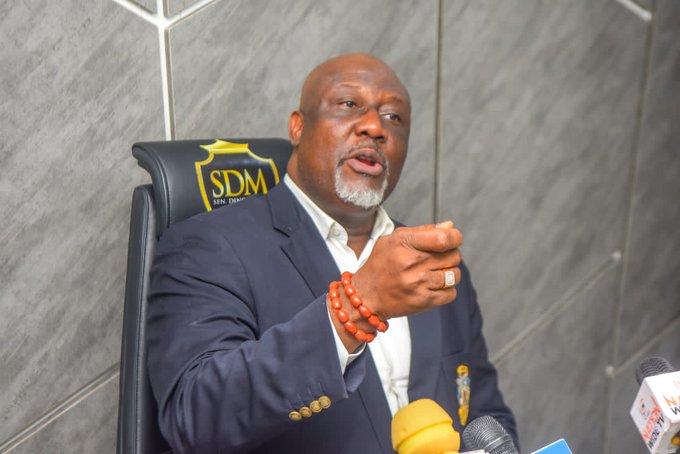
Former Kogi West Senator Dino Melaye has issued a 14-day ultimatum to the leadership of the National Assembly, warning that Nigerians will march on the legislature in a massive protest if lawmakers fail to reclaim their constitutional independence and stop what he describes as the dangerous surrender of legislative authority to President Bola Ahmed Tinubu.
Melaye, a lawyer and chieftain of the African Democratic Congress (ADC), delivered the warning during a press conference in Abuja on Wednesday, October 14, 2026, where he accused Senate President Godswill Akpabio and Speaker of the House of Representatives, Tajudeen Abbas, of presiding over a legislature that has become increasingly unwilling to question executive decisions.
His message was unmistakable: the National Assembly was elected to represent Nigerians, not to serve as an administrative department of the Presidential Villa.
The former lawmaker, who currently serves as Deputy Director-General for Contact and Mobilisation of the ADC presidential campaign, warned that unless the leadership of the 10th National Assembly addresses the constitutional, electoral and financial accountability concerns raised in his presentation, Nigerians would be mobilised for an Occupy National Assembly protest.
“We are giving the National Assembly 14 days to respond in corrective lines to all our demands and all grey areas where they have disappointed Nigeria and Nigerians; failure to do so, we will march on the National Assembly, and it will be very loud,” Melaye declared.
Melaye’s criticism went beyond the conduct of individual lawmakers. He questioned the future of Nigeria’s constitutional democracy under a legislature that, in his assessment, has increasingly treated presidential requests as instructions rather than proposals requiring independent scrutiny.
Drawing a comparison with the Eighth National Assembly, Melaye recalled the emergence of Bukola Saraki as Senate President and Yakubu Dogara as Speaker of the House of Representatives, arguing that their leadership demonstrated how Parliament could assert its independence despite opposition from the executive.
He maintained that when lawmakers freely determine their leadership, the legislature is better positioned to question the Presidency and protect the interests of citizens.
But where legislative leadership is beholden to the executive, he argued, Parliament risks losing the independence that gives democracy its meaning.
“Parliament becomes a parastatal of the Villa. It becomes a department of the Presidency,” Melaye said.
The former senator challenged the notion that cooperation between the executive and legislature must translate into unquestioning acceptance of government policies.
He insisted that the constitutional separation of powers was designed precisely to prevent any President, regardless of political affiliation, from exercising authority without effective institutional restraint.
In his presentation titled The 10th Assembly: The Pathway to Tinubu’s ‘Lifetime Presidency’, Melaye raised questions about the rapid passage of executive-sponsored legislation, the handling of electoral reforms, the declaration of emergency rule in Rivers State, discrepancies in tax legislation and the oversight of federal expenditure.
He specifically questioned the July 2024 amendment to the Nigeria Police Act, which passed through all three readings in both legislative chambers on the same day.
According to him, the speed of the process raised legitimate concerns about whether lawmakers subjected the proposal to sufficient scrutiny.
On the March 2025 declaration of emergency rule in Rivers State, Melaye questioned the use of voice votes to approve a proclamation requiring a constitutionally prescribed two-thirds majority.
He also demanded greater accountability over reported discrepancies between versions of Nigeria’s tax laws and challenged the National Assembly’s handling of contentious provisions in the Electoral Act 2026.
Turning to public expenditure, Melaye cited approximately ₦26.22 trillion in Service-Wide Vote allocations across the 2024, 2025 and 2026 budgets, demanding greater transparency in how such funds are released, monitored and spent.
He further raised concerns about proposals for a single six-year presidential term, warning that any future constitutional amendment must clearly protect against the extension of an incumbent President’s tenure beyond the mandate under which that President was elected.
The proposal has not been enacted, and Melaye did not establish that President Tinubu has obtained or is legally entitled to an extension of his tenure. His argument centred on the need for constitutional safeguards before any such amendment is considered.
For Melaye, the central issue is not whether the National Assembly has passed enough bills, conducted hearings or maintained cordial relations with the Presidency. It is whether lawmakers have demonstrated the courage to disagree with the executive when the Constitution and public interest demand it.
He warned that democratic institutions become vulnerable when those entrusted with defending them abandon their responsibility.
The former senator maintained that his criticism was not an attack on legitimate cooperation between arms of government, but a demand that Parliament recover its constitutional authority.
He reminded lawmakers that their loyalty must remain with the Constitution and the Nigerian people rather than with any individual occupying the Presidency.
As the 14-day ultimatum begins to run, Melaye has placed the leadership of the National Assembly under renewed public scrutiny.
His final warning was a declaration that elected office does not place lawmakers above the citizens whose mandate they hold.
“If the National Assembly refused to become truly independent and ameliorate issues that have been raised in this press briefing, we are going to prove to members of the National Assembly that Nigeria is greater than members, than sitting members of the National Assembly,” he declared.
With that warning, Melaye has shifted his confrontation with the leadership of the 10th National Assembly from criticism of its performance to the prospect of organised public protest.
Whether the legislature responds to his demands or challenges his allegations remains to be seen. What is clear is that Melaye has made legislative independence, constitutional accountability and the limits of presidential power the centre of his latest political confrontation.
Related News:
- Dino Melaye Accuses National Assembly of Surrendering to Tinubu, Warns of ‘Lifetime Presidency’
- Dino Melaye Challenges IBA Tax Panel, Demands African Voice in Digital EconomyDebate
- We Will Make Nigeria Affordable Again Dino Melaye


behind Games Village, Abuja
5A, CGH, Games Village, Abuja