

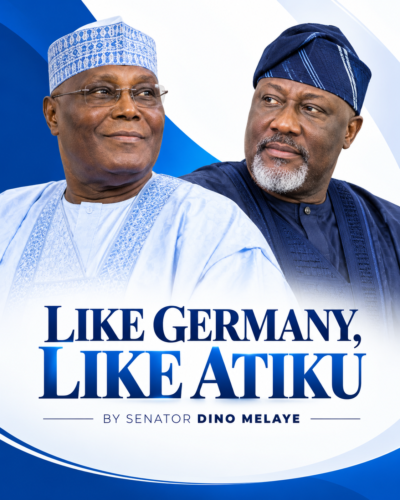
Former Kogi West Senator Dino Melaye has drawn a direct comparison between Germany’s latest fuel-price intervention and the subsidy proposal of African Democratic Congress presidential candidate Atiku Abubakar, arguing that governments should not leave citizens to absorb the full impact of major energy shocks.
In an intervention titled “Like Germany… Like Atiku,” Melaye said Germany’s decision to reduce the tax burden on petrol and diesel demonstrates that even wealthy economies intervene when extraordinary energy costs threaten households and businesses.
Germany introduced a temporary fuel-tax reduction from October 1, 2026, cutting the effective tax burden on petrol and diesel by approximately 17 euro cents per litre through the end of the year. The measure is expected to cost federal and state governments about €2.5 billion and was introduced as energy prices rose sharply amid continued geopolitical instability.
For Melaye, the policy carries a political and economic lesson for Nigeria.
He argues that fuel is not merely another commodity in the household budget but a price that feeds directly into transportation, food distribution, business operating costs, electricity generation and the broader cost of living.
According to him, once the price of petrol rises substantially, the effect spreads across virtually every part of the economy.
That position closely reflects Melaye’s earlier argument that the ADC intends to “make Nigeria affordable again”, with cheaper energy forming a central part of that proposition. LegalLinkz previously reported that he believes a properly designed subsidy intervention could substantially reduce petrol prices and consequently ease pressure on transportation and commodities. legallinkz.com
Germany’s Intervention Becomes Melaye’s Reference Point
Germany’s intervention comes amid a wider global energy shock.
German inflation rose to 3.3 per cent in September, its highest level in almost three years, while energy inflation accelerated sharply. The government responded with temporary relief for motorists rather than leaving pump prices entirely exposed to the international shock. Reuters
Melaye says that approach supports Atiku’s argument that governments can intervene temporarily when energy costs become unbearable.
His argument is straightforward: if one of the world’s largest economies considers direct relief appropriate during a crisis, Nigeria — where households generally possess far less financial cushioning — cannot dismiss every form of support as economically irresponsible.
“Germany is one of the richest economies on earth, and its government still decided that when a global crisis hits, citizens should not carry the burden alone,” Melaye said in the statement.
He linked that approach to Atiku’s campaign proposal to restore some form of petrol subsidy if elected in 2027.
Atiku has repeatedly said his position is to bring subsidy back, arguing that Nigerians have endured severe hardship following its removal and questioning whether the savings have translated sufficiently into improvements in healthcare, education, security and living conditions.
Atiku’s Proposal Is Not Without Opposition
The subsidy debate remains highly contested.
The Tinubu administration removed petrol subsidy in 2023, arguing that the previous system was fiscally unsustainable, vulnerable to abuse and consumed resources that could otherwise support public investment.
Atiku’s proposal has therefore attracted strong criticism from the ruling APC and some economic policy groups.
The Centre for the Promotion of Private Enterprise, for example, has warned that returning to a broad petrol subsidy could recreate significant fiscal pressure and has instead advocated more targeted relief for vulnerable households and businesses.
The APC has also asked Atiku to explain the legal, financial and operational structure of his proposed intervention, particularly how it would reduce pump prices without recreating the problems associated with the previous subsidy regime.
Atiku’s camp has responded that the proposal would not simply reproduce the old import-subsidy model.
His spokesperson, Paul Ibe, has said the intervention would be temporary and linked to domestic crude supply and refining, with the intention of giving households and businesses breathing space before the support is eventually phased out.
That distinction is important.
Germany’s current measure is also temporary. It is a tax reduction responding to an energy shock, not a permanent commitment to below-market fuel prices.
The comparison Melaye is making is therefore political rather than technically identical: both approaches involve government choosing to absorb part of an energy-price shock rather than passing the entire burden directly to consumers.
‘Fuel Is the Price Beneath Other Prices’
Melaye’s central argument is that Nigeria’s cost-of-living crisis cannot be separated from energy prices.
Transportation affects the movement of food from farms to markets.
Manufacturers depend on diesel, petrol and electricity.
Small businesses frequently rely on generators.
Schools, healthcare providers and service businesses all face higher operating expenses when energy costs rise.
As a result, Melaye argues, the price of fuel eventually appears in the price of almost everything else.
His position is that reducing the energy burden could therefore have an economy-wide effect rather than benefit motorists alone.
He has previously said Atiku’s proposed intervention could bring petrol prices substantially below their current levels, although such estimates remain campaign projections rather than independently established outcomes.
A Question Nigerians Will Have to Decide
Melaye’s Germany comparison adds another dimension to what is likely to become one of the defining economic arguments of the 2027 presidential campaign.
The issue is no longer simply whether Nigeria once operated a corrupt or inefficient subsidy system.
The harder question is whether a different, more transparent and targeted form of state intervention can protect consumers without recreating the fiscal burden and leakages associated with the former regime.
For Atiku and Melaye, the answer is yes.
For the APC and many subsidy critics, the greater danger lies in reopening a system Nigeria spent years trying to dismantle.
Germany’s temporary response to its own energy crisis will not settle that argument.
But it gives Melaye a politically potent question to place before Nigerian voters:
If wealthy countries still step in when energy prices threaten their citizens, why should Nigerians be told that enduring the full pain is the only path to reform?
Related Stories
READ MORE: “We Will Make Nigeria Affordable Again” — Dino Melaye legallinkz.com
READ MORE: Dino Melaye Faults Tinubu on Debt, Insecurity, Cost of Governance legallinkz.com
READ MORE: Dino Melaye Calls Youths to Faith, Purpose and Service legallinkz.com