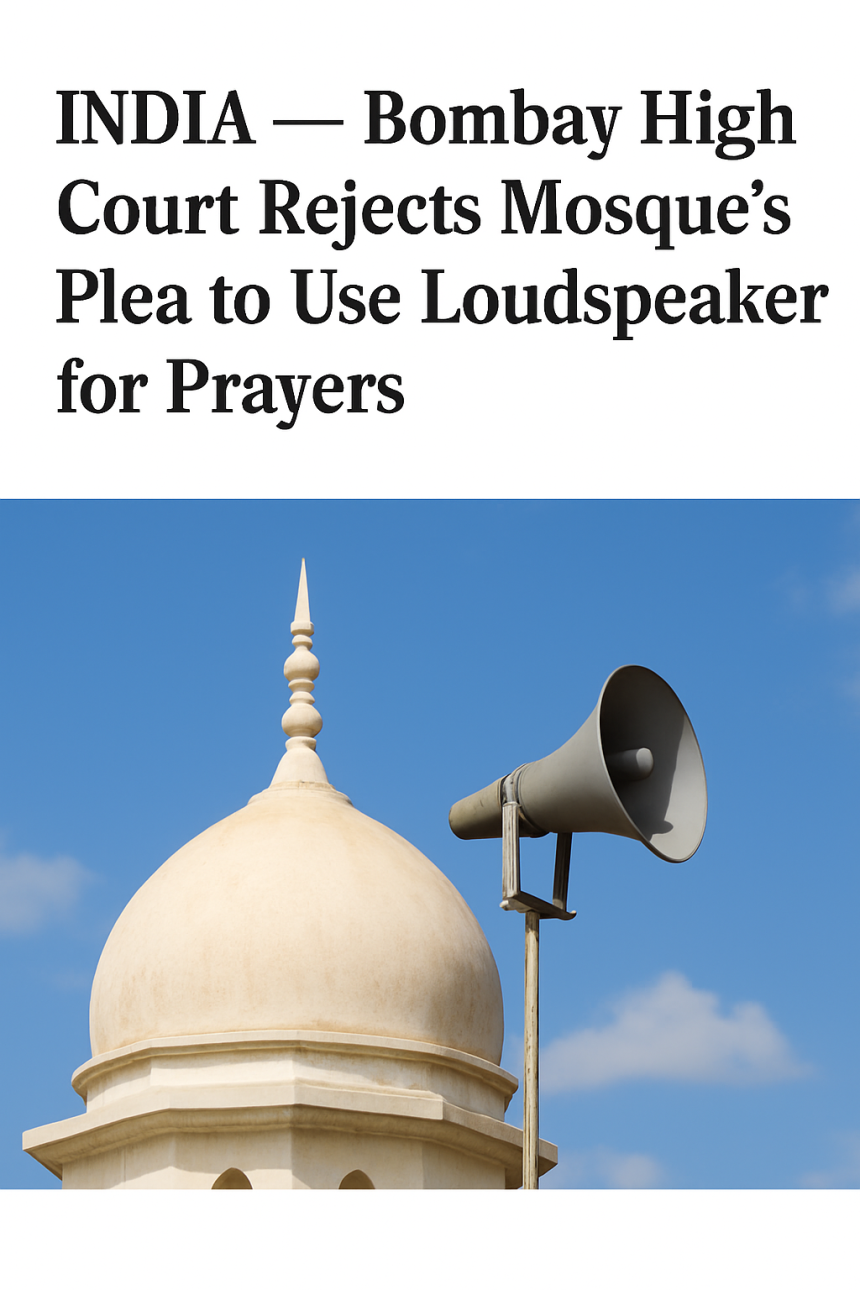
The Nagpur Bench of the Bombay High Court has dismissed a petition filed by Masjid Gousiya in Gondia district seeking permission to use a loudspeaker for prayers, ruling that no religion grants an absolute right to use voice-amplifying devices for worship.
In the detailed order dated December 1, the Bench of Justices Anil Pansare and Raj Wakode emphasised that the petitioner failed to produce any material showing that the use of loudspeakers is a mandatory or essential part of practising their faith.
The court held that loudspeakers cannot be demanded as a matter of religious right.
Drawing from multiple Supreme Court decisions, the Bench reiterated that no religion prescribes prayer in a manner that disturbs others’ peace, nor mandates the use of amplifiers, drums, or similar devices.
The judges highlighted that citizens, including children, the elderly, the sick, and those with psychological conditions, are entitled to reasonable quietness.
The High Court also took suo motu cognisance of recurring noise pollution issues across Maharashtra and urged the State government to develop a more effective, enforceable solution.
The order went further to underline the severe public-health impact of noise pollution.
The Bench observed that excessive noise triggers the body’s “fight or flight” response, releasing harmful chemicals like cortisol into the bloodstream.
Prolonged exposure can lead to hypertension, cardiovascular diseases, headaches, chronic fatigue, mental-health disorders, and even aggressive behaviour. The judges added that noise beyond 120 decibels risks rupturing the eardrum.

Beyond the immediate case, the court noted widespread violations of noise-control rules during events at social venues in Nagpur’s Civil Lines and during religious activities where bhajans and other amplified performances are conducted without adherence to regulations.
It held that event halls and organisers must take responsibility for ensuring compliance with noise-pollution standards.
Expressing hope that the State would act decisively, the Bench stressed that the issue affects public health at large and requires a sensitive and structured response.
The petition by Masjid Gousiya was ultimately dismissed, reaffirming the judiciary’s consistent stance that the right to practise religion does not extend to creating noise pollution or disturbing public tranquillity.