

Former senator says rising federal allocations demand answers as Nigerians battle hardship, but the distinction between budgeted funds and money actually spent remains critical.
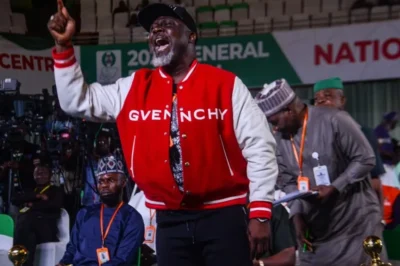
Former Kogi West senator Dino Melaye has challenged President Bola Tinubu’s administration over federal spending priorities, demanding greater transparency in the management of Service-Wide Votes and accusing the National Assembly of failing to provide effective scrutiny of public expenditure.
At a meeting with members of the African Democratic Congress (ADC) from Ekiti State and some House of Representatives aspirants in Abuja, Melaye cited approximately ₦26.22 trillion in Service-Wide Vote allocations across the 2024, 2025 and 2026 budgets. He argued that such a massive allocation demands clear explanations, particularly at a time when many Nigerians continue to struggle with the cost of living.
The former lawmaker’s remarks, reported on October 23, put the spotlight on a question that goes beyond partisan politics: what has the government actually done with the public funds approved in successive budgets, and how effectively has the National Assembly monitored their use?
‘The National Assembly Has Become a Parastatal of the Villa’
Melaye, who previously served in both the House of Representatives and the Senate, questioned the independence of the National Assembly under the current administration.
He described the legislature as a “parastatal of the Villa”, arguing that lawmakers were not asking sufficient questions about the President’s spending priorities and the implementation of federal budgets.
According to figures cited by Melaye and previously reported by PUNCH, Service-Wide Vote allocations stood at approximately ₦4.08 trillion in 2024, ₦9.31 trillion in 2025 and ₦12.83 trillion in 2026. The combined figure is about ₦26.22 trillion.
“In three years, Tinubu has spent ₦26 trillion as service-wide votes. No question from the National Assembly, no oversight,” Melaye alleged.
He argued that the scale of the allocations made stronger legislative scrutiny essential, insisting that the National Assembly must do more than approve budget proposals. In his view, lawmakers should demand detailed explanations of how public money is released, spent, and accounted for.
Melaye’s central complaint was that Nigerians were enduring severe economic pressure while the government’s spending priorities and the accountability mechanisms surrounding them remained matters of public concern.
The ₦26.22 Trillion Claim: What the Budget Records Actually Show
The figures raise important questions, but the distinction between an allocation and actual expenditure must not be lost.
The reported amounts are budget allocations. They do not, by themselves, establish that the entire ₦26.22 trillion was released from the Treasury and spent. Establishing actual expenditure requires evidence of releases, payments, implementation records and the relevant audit trail.
That distinction is particularly important in assessing the 2026 figure.
In July, the Budget Office of the Federation rejected the description of the ₦12.83 trillion Service-Wide Vote as an unrestricted pool of money available to the Presidency. Its explanation, reported by Metro Daily, said the figure covered several categories of government obligations, including approximately ₦2.18 trillion for personnel costs, ₦1.52 trillion for other recurrent expenditure and ₦9.12 trillion for capital expenditure.
The Budget Office said these provisions covered obligations such as salary and wage adjustments, pensions, security operations, immunisation, social programmes, legacy liabilities and donor-supported projects.
The government’s position is that the allocation is made up of identified obligations rather than a single discretionary cash fund. The Budget Office has also explained, in a separate statement published by the State House, that appropriation provides legal authority for expenditure but does not automatically mean money has been released or paid.
That explanation is a necessary part of the public record. It does not, however, remove the need for transparency over implementation.
Nigerians should be able to distinguish between what was approved, what was released, what was actually paid, what obligations were settled and what remained unspent. Those figures are essential to determining whether public money delivered value.
Melaye Connects Government Spending to the Hunger Crisis
Beyond the budget figures, Melaye delivered a sharp warning about the hardship facing Nigerians.
He described the hunger experienced by citizens as only a “preliminary” stage and warned that conditions could become worse if Tinubu secured another term in office.
His remarks reflected his broader criticism of the administration’s spending priorities. He questioned the cost of presidential vehicles and aircraft, arguing that government expenditure must be examined against the economic realities confronting ordinary Nigerians.
The former senator also used the phrase “drug dealers in power” during his political attack. That was his rhetoric, not an established finding of criminal conduct against any individual.
Melaye’s warning was blunt: government must be judged not only by the size of its budgets or the promises attached to them, but by whether its decisions improve the lives of citizens.
The National Assembly Faces an Accountability Test
The controversy places renewed attention on the oversight responsibilities of the National Assembly.
Approving a budget is not the end of parliamentary responsibility. Effective scrutiny also requires lawmakers to examine implementation, question unexplained spending, review audit findings and seek evidence that appropriated funds were used for their authorised purposes.
For the ₦26.22 trillion figure to be properly assessed, the public needs a clear account of the annual allocations, the amounts released, the actual expenditure, the purposes for which payments were made and the outcomes achieved.
The Presidency and relevant fiscal authorities should make the supporting information accessible, while the National Assembly should demonstrate how it has monitored the spending and addressed any gaps identified.
Melaye’s allegations of inadequate oversight remain political claims, but the questions surrounding public expenditure are legitimate matters for public scrutiny. The available figures alone do not prove that the full amount was spent improperly—or that it was all spent at the president’s personal discretion.
The real test is whether the government can provide a transparent, verifiable account of the money and whether lawmakers will independently examine that account.
For Nigerians facing rising living costs, the issue is not simply whether ₦26.22 trillion is a large number. It is whether public spending can be traced, justified, and measured against the needs of the country.
The question now is straightforward: what was actually spent, what did Nigerians receive in return, and will the National Assembly insist on answers?
Related News:
Dino Melaye Gives National Assembly 14 Days, Threatens Mass Protest
Dino Melaye Accuses National Assembly of Surrendering to Tinubu, Warns of ‘Lifetime Presidency’


behind Games Village, Abuja
5A, CGH, Games Village, Abuja