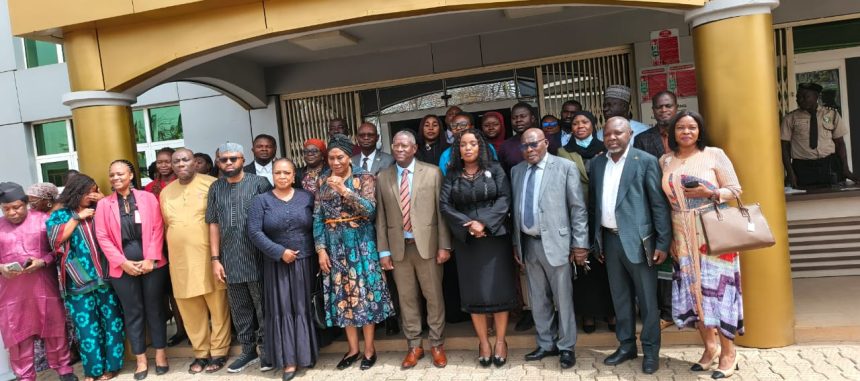
At a high-level engagement on the enforcement of judgments of the ECOWAS Community Court of Justice, Mojirayo Ogunlana, a legal practitioner and civil society advocate, delivered a compelling address highlighting Nigeria’s outstanding obligations and the human consequences of delayed justice.
Addressing the Honourable President and Judges of the Community Court of Justice, court officials, government representatives, civil society actors, and members of the legal community, Ogunlana spoke from over 14 years of experience at the Bar and nearly a decade of practice before the ECOWAS Court. She emphasized that the discussion on enforcement strikes at the core of justice, human rights, and the rule of law within the West African region.
According to her, Nigeria currently has approximately 50 judgments of the ECOWAS Community Court of Justice that remain unenforced. She stressed that the Court was established not as a symbolic institution, but as a mechanism to ensure accountability, protect fundamental rights, and strengthen regional integration grounded in justice. Over time, she noted, the Court has become a critical avenue for victims of human rights violations, particularly where domestic remedies are ineffective, delayed, or inaccessible.
“Yet, a judgment without enforcement is justice deferred and, in many cases, justice denied,” she stated.

Ogunlana illustrated the urgency of the issue by recounting the case of Beauty Igbobie Uzezi, widely known as the Airforce woman’s case. She explained that Uzezi, who alleged that she was brutally raped in 2011 at age 19 by a superior officer, Flight Lieutenant B.S. Vibelko, faced intimidation, harassment, and eventual dismissal from the Nigerian Air Force without proper court-martial procedures after reporting the incident.
The ECOWAS Court, following its analysis, held that her dismissal was illegal, that her fundamental rights had been violated, and awarded $200,000 in damages against the Nigerian government. The Court further ordered the conversion of her dismissal to retirement with full benefits and directed the Nigerian Air Force to investigate and prosecute the named officer.
Ogunlana disclosed that between 2023 and 2025, she represented Uzezi in efforts to secure enforcement of the judgment, writing repeatedly to the Attorney-General of the Federation and copying the Nigerian Air Force. However, she stated that attempts to secure engagement yielded no result, with repeated feedback that correspondence could not be found in official records. She described the ongoing emotional and psychological toll on her client, noting that the officer identified in the judgment continues to rise through the ranks.
She stressed that Uzezi’s case is only one among many, with approximately fifty ECOWAS Court judgments against Nigeria still awaiting enforcement. Behind each, she said, is a citizen, family, or community waiting for justice to become real.
Ogunlana warned that persistent non-enforcement weakens the credibility of the regional judicial system, undermines public confidence in the rule of law domestically, and leaves victims in prolonged uncertainty. She acknowledged Nigeria’s historic leadership role within ECOWAS but emphasized that such leadership must equally be reflected in compliance with regional judicial decisions.

While recognizing that enforcement challenges may arise from institutional coordination gaps, administrative delays, budgetary constraints, or limited awareness among implementing agencies, she insisted that these must not serve as permanent justifications for inaction.
She proposed several pathways forward, including the establishment of a clear national framework for implementation of ECOWAS Court judgments with designated focal agencies; structured dialogue between national judges, government ministries, and the Court; stronger parliamentary oversight; creation of a publicly accessible register of ECOWAS judgments and their implementation status; and expanded capacity building and awareness on regional law.
Civil society, she noted, stands ready to collaborate with governments, regional bodies, and the judiciary to develop sustainable enforcement mechanisms.
“The authority of a court lies not only in the wisdom of its judgments but in the willingness of States to honour them. Enforcement is not an optional act of goodwill; it is a legal and moral obligation arising from membership in a rules-based regional community,” she said.
She concluded by urging Nigeria to transform pending judgments into concrete action, reaffirming its commitment to justice and strengthening regional institutions.
Mojirayo Ogunlana, Digital, Media and Gender Rights Activist and Executive Director of Digicivic Initiative, spoke on behalf of Civil Society in Nigeria.
Photos:



Read More: