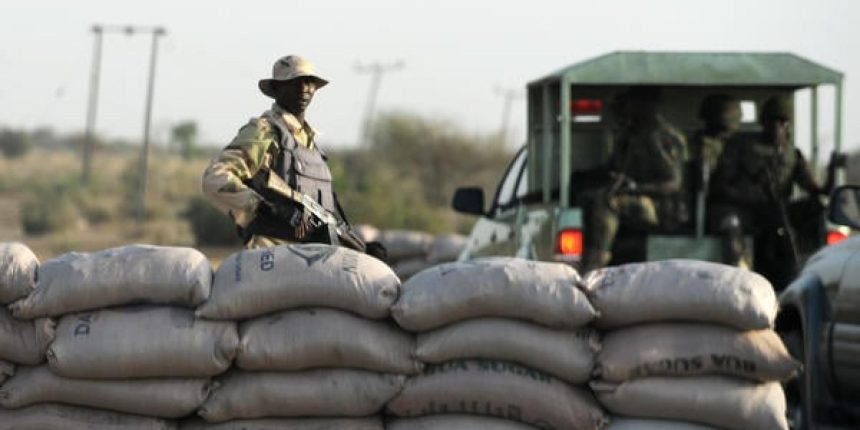
The Defence Headquarters (DHQ) has directed the immediate dismantling of all non-essential roadblocks and unauthorized checkpoints mounted by military units across several major highways in Nigeria, citing operational lapses, mobility constraints, and increased risks to both civilians and security personnel.
The order, contained in an internal communication dated December 5, 2025, and signed by Brigadier General A. Rabiu “for CDS”, directed Theatre Commanders (TCs) and Formation Commanders (FCs) to enforce strict compliance without delay.
According to the DHQ, the military leadership has “observed a growing proliferation of non-essential static roadblocks and checkpoints along several routes within the Joint Operations Area (JOA),” a development it described as counterproductive to ongoing security operations.
The memo warns that the uncontrolled expansion of roadblocks has begun to undermine operational efficiency, disrupt free movement for civilians and security operatives, and expose deployed troops to avoidable threats, especially on long-distance highways frequently targeted by criminal groups.

Critical Routes Affected by the Order
The directive cited several major national corridors where the presence of these unauthorized checkpoints has spiked, including:
- Abuja–Lokoja–Ajaokuta–Idah–Otukpa–Obollo Afor–Enugu
- Abuja–Lokoja–Obajana–Kabba–Omuo–Ekiti–Ikole Ekiti
- Abuja–Lokoja–Okene–Okpella–Auchi–Benin
- Abuja–Kaduna–Kano
- Lagos–Ore–Benin–Asaba–Niger Bridge
These highways are some of Nigeria’s busiest transit points for both commercial and passenger movement and have been areas of recurring security concerns ranging from kidnapping to armed robbery and insurgency spillovers.
DHQ’s New Enforcement Framework
The Defence Headquarters emphasized that:
- Only DHQ-approved control points may remain operational.
- Commanders must immediately take down all unauthorized and redundant checkpoints.
- Troops are to pivot from static blocking positions to mobile, intelligence-driven operations.
- Field commanders must increase aggressive patrols, reconnaissance missions, and human intelligence (HUMINT) gathering.
The communication stressed that “only essential control points required strictly for operational and security purposes” should remain, while commanders should “dominate the expanse of routes with aggressive mobile patrols.”
Context and National Security Implications
The directive comes at a time of escalating insecurity across multiple regions, including:

- Rising incidents of kidnapping-for-ransom along intercity highways.
- Increased banditry and armed attacks in the North-West and North-Central.
- Heightened public complaints regarding delays, extortion, and harassment at some roadblocks.
- Concerns about overexposure of soldiers, making them easy targets for ambush.
Analysts note that although roadblocks were initially introduced to facilitate stop-and-search operations, many have become static points where troops are vulnerable to surprise assault—particularly at night.
Security experts argue that in modern asymmetric warfare, mobility, rapid response, and intelligence gathering are more effective than static checkpoint operations, which criminals easily study and circumvent.
Furthermore, with Nigeria’s ongoing struggle against insurgency, banditry, and criminal networks, the military’s shift to intelligence-led mobility strategies is seen as an attempt to modernize field operations and reduce operational fatigue on personnel.
Public Reception and Possible Outcomes
The directive is expected to generate mixed reactions:
- Motorists and logistics operators may welcome faster travel and reduced delays.
- Local communities may fear exposure to unchecked movement of armed groups without visible checkpoint presence.
- Troops may benefit from reduced risk and improved operational tactics.
Security stakeholders, however, stress that effectiveness will depend heavily on how quickly commanders implement the directive and how well mobile patrols are coordinated across states.
The Defence Headquarters’ order marks one of the most decisive attempts in recent years to restructure military presence on Nigerian highways. As insecurity continues to evolve, the success of this policy will hinge on disciplined implementation, improved intelligence systems, and sustained coordination between the military, police, and other security agencies.
Also Read:
El-Zakzaky Levels Shocking Allegations: Accuses US of Creating and Funding Boko Haram, ISWAP, and ISIS