


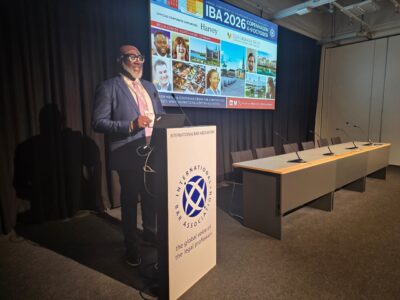
COPENHAGEN, DENMARK — Senator Dino Melaye, Esq., has drawn attention at the ongoing International Bar Association Annual Conference 2026 in Copenhagen following his intervention during discussions on the rule of law, democratic accountability and the relationship between governments and citizens.
Reflecting on Melaye’s participation, Dr. Isaac Newton Ogunrinde, Coordinator of the One ADC Movement in Ekiti State, described the former Senator’s intervention as a significant moment for Nigeria’s voice within an international legal forum.
In a commentary titled “The Copenhagen Moment: How Senator Dino Melaye’s Voice at the IBA Redefined Nigeria’s Place in Global Politics,” Ogunrinde said Melaye used the conference to raise questions that went beyond technical legal discussions and addressed the broader relationship between power, democracy and the rights of citizens.
He particularly highlighted Melaye’s contribution during the session “The Rule of Law in a Trump Era,” where the Nigerian politician and lawyer spoke about the need for governments to tolerate criticism and regard citizens who demand accountability as participants in democratic governance rather than enemies of the state.
According to Ogunrinde, the central message of Melaye’s intervention was that the rule of law must be applied consistently and should not become dependent on who controls political power.
He said Melaye’s remarks drew attention to a concern increasingly shared across jurisdictions: that democracy becomes vulnerable where courts lose independence, dissent is criminalised or opposition voices are treated primarily as security threats.
A major point highlighted in the intervention was Melaye’s argument that asking government to act responsibly should not itself be regarded as an offence.
“Asking government to do the right thing should not be seen as an offence, but as an offer for a leader to have peaceful coexistence with the people,” Melaye said.
Ogunrinde interpreted the statement as an attempt to redefine constructive criticism as an important part of democratic governance.
In his view, citizens who question government policy or demand accountability are not necessarily acting against the state; they can also be helping government identify grievances before those grievances become deeper social conflicts.
He further argued that Melaye’s intervention carried particular relevance for lawyers and human-rights advocates because it connected abstract discussions about the rule of law with the everyday experiences of citizens.
According to Ogunrinde, the intervention reminded delegates that the effectiveness of law should ultimately be measured by what it means for ordinary people, including those seeking justice, challenging public institutions or exercising their right to disagree with government.
Ogunrinde also drew attention to Melaye’s comments on the international influence of the United States.
He said Melaye acknowledged the historic role of the United States in promoting democratic institutions and the rule of law internationally, while questioning whether that influence can remain credible without consistency in the application of democratic principles.
The argument, as presented by Ogunrinde, was that powerful countries cannot sustainably advocate one standard of justice internationally while appearing to apply another standard when their own political interests are involved.
He said the same principle should apply to every democracy, including Nigeria: the credibility of a government’s commitment to the rule of law depends not simply on its declarations, but on how institutions respond to criticism, political opposition, protests and demands for accountability.
For Ogunrinde, Melaye’s contribution was also important because it projected a Nigerian perspective into a conference attended by lawyers and legal professionals from different parts of the world.
He argued that African lawyers and political actors should participate more actively in international discussions about democracy, human rights and governance rather than allowing such conversations to be framed almost exclusively from outside the continent.
Ogunrinde described Melaye’s intervention as an effort to reconnect high-level legal debates with the concerns of ordinary citizens.
In his assessment, the Copenhagen appearance reflected a simple democratic proposition: governments are strengthened, rather than weakened, when citizens are free to question them.
He concluded that political power is temporary, while institutions and citizens endure beyond individual administrations.
“Power is temporary. The people are permanent. And history will only remember those who stood with the people when it was risky to do so,” Ogunrinde wrote.
For him, Melaye’s participation in Copenhagen was therefore not merely an appearance at an international legal conference, but an opportunity to place questions of accountability, civic freedom and the relationship between government and governed before a global legal audience.
By Dr. Isaac Newton Ogunrinde
Coordinator, One ADC Movement, Ekiti State, Nigeria
Related Stories
READ MORE: IBA Copenhagen 2026 Opens With Nigerian Lawyers in Key Roles Nigerian Law Updates
READ MORE: Nigerian Judge, Lawyers Take Centre Stage at IBA Copenhagen Nigerian Law Updates
READ MORE: IBA Warns of Rule-of-Law Gaps as Nigeria Joins Global Survey Nigerian Law Updates