

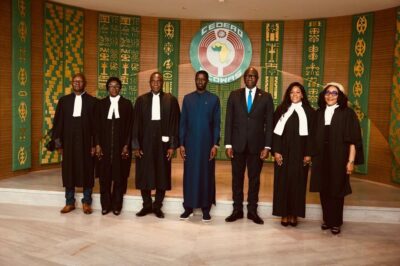
The Community Court of Justice, ECOWAS, has entered a new judicial phase following the formal swearing-in of five judges appointed to serve the regional court for a four-year, non-renewable term.
The new judges took the oath of office in Abuja before H.E. Bassirou Diomaye Faye, President of Senegal and Chairman of the Authority of Heads of State and Government of ECOWAS, formally committing themselves to discharge their responsibilities with independence, impartiality and integrity.
The new members of the Court are Justice Désiré Henri Aihou of Benin, Justice Awa Bah of The Gambia, Justice Charlyne M. Brumskine of Liberia, Justice Henrietta Uzoamaka Didigu of Nigeria, and Justice Yaouza Ouro-Sama of Togo. They replace the five judges whose tenure at the Court has ended.
Addressing the judges, President Faye placed judicial credibility at the centre of his charge, telling the new Bench that the standing of the ECOWAS Court will be measured not merely by its institutional status, but by the quality of its decisions and the trust those decisions inspire.
He urged the judges to remain faithful to their oath throughout their tenure and to help consolidate the Court’s achievements while modernising its work in response to changing regional realities.
According to the President, the Court must continue moving toward a system of Community justice that is more effective, accessible and people-centred. E
His remarks came against the background of what he described as an especially difficult period for West Africa, marked by political, economic, security and environmental pressures.
Faye said those challenges make the rule of law and regional cooperation even more important, stressing that the ECOWAS Court has a central responsibility to enforce Community treaties and legal instruments while protecting the rights of citizens across Member States. ECOWAS Court PR – New Judges fo…
The message was reinforced by Justice Mouhamadou Mansour Mbaye, Chairman of the ECOWAS Judicial Council and First President of the Supreme Court of Senegal, who described judicial independence as an obligation owed to litigants rather than a privilege enjoyed by judges.
His intervention placed particular emphasis on the personal character expected of members of the regional Bench — independence, impartiality, integrity and courage.
He told the new judges that their independence must remain constant, their impartiality unquestionable and their integrity beyond reproach.
That message strikes at the core of the Court’s legitimacy.
Unlike a purely domestic court, the ECOWAS Court hears disputes within a regional system involving sovereign Member States, Community institutions and individuals seeking remedies, including in matters touching on fundamental rights.
Its effectiveness therefore depends not only on the formal authority conferred by ECOWAS instruments, but also on whether litigants and governments regard its judges as independent actors applying Community law without political or personal influence.
Justice Mbaye also described the swearing-in as a moment of renewed confidence in those selected to guide the future of Community justice, noting the Court’s contribution to the gradual development of a distinct West African legal system.

In an earlier welcome address, H.E. General Birame Diop, President of the ECOWAS Commission, paid tribute to the outgoing judges for their contribution to the institution and the wider Community.
Diop said the oath taken by the incoming judges must be understood as more than a ceremonial formality.
He described it as a solemn commitment to carry out judicial responsibilities with integrity, impartiality and conscientiousness — not only before the Chair of the Authority, but in service to every citizen of the Community.
He also pledged the Commission’s support for the Court in the discharge of its mandate while calling for deeper cooperation among ECOWAS institutions, Member States and national courts.
The Commission President urged the judges to set aside personal interests and allow the obligations of their office to guide their service to the region.
The composition of the new Bench brings together judges from Benin, The Gambia, Liberia, Nigeria and Togo, giving the Court representation across different legal traditions within the Community.
For Nigeria, the appointment of Justice Henrietta Uzoamaka Didigu preserves the country’s representation on the five-member Court at a time when the institution continues to occupy an increasingly important place in regional human-rights and Community-law adjudication.
The ceremony itself drew high-level participation from ECOWAS Member States and institutions, the diplomatic community, judicial authorities, legal practitioners, members of the media and officials of ECOWAS institutions.
The larger significance of the transition, however, will emerge not from the ceremony but from the judgments that follow.
Over the next four years, the new judges will be called upon to interpret Community law, determine disputes and confront difficult questions of rights, state responsibility, institutional authority and regional integration.
Their work will also test the very standards repeatedly emphasised at the swearing-in: independence, impartiality, integrity and public confidence.
For the ECOWAS Court, a new Bench has now taken office.
The next chapter will be written in its decisions.
Related Stories
READ MORE: ECOWAS Court Enters New Judicial Era as Five Judges Take Oath in Abuja
READ MORE: ECOWAS Court Targets Judgment Enforcement Gaps
READ MORE: Fagbemi Calls for Stronger Enforcement Mechanisms for ECOWAS Court