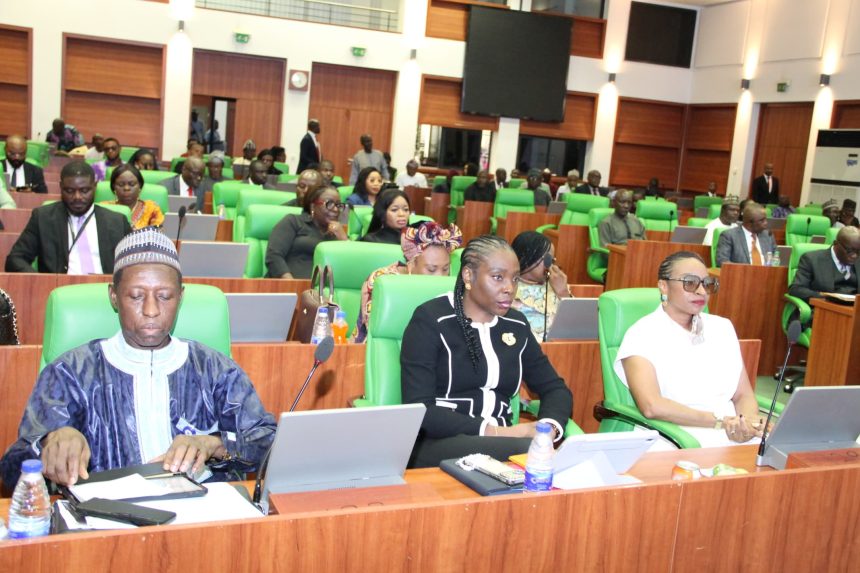
Prof. M. T. Ladan, Coordinating Director, AfCFTA Law and Policy Programme Division, Office of the Director-General, National Institute for Legislative and Democratic Studies (NILDS), Abuja, on Monday, 27th July 2026, presented the summary of a memorandum submitted by his team at the Public Hearing on the AfCFTA Domestication Bill, 2026 (HB 2765), organised by the House of Representatives Committee on Commerce at the National Assembly, Abuja.
The memorandum was submitted by Prof. M. T. Ladan alongside members of the NILDS team, Dr. Usman Ibrahim and Dr. Shamsu Yahya.
Key Observations
1. Comprehensiveness vs. Governance Gaps – HB 2765 offers the most comprehensive framework for implementing the AfCFTA in Nigeria compared to previous bills.
2. Need for Stronger Oversight and Accountability – The Treaties (Making Procedure, Etc.) Act (Amendment) Bill, 2026 provides important oversight, reporting, and accountability mechanisms that are missing from HB 2765.
3. Institutional Coordination and Stakeholder Inclusion – HB 2765 establishes relevant committees but does not adequately ensure cross-agency coordination or the inclusion of diverse stakeholders, including the National Assembly, state governments, business and civil society.
4. Reporting and Evaluation Deficits – There is no requirement for regular implementation reporting, economic impact assessments, or measurable performance indicators in HB 2765.
5. Procedural and Legal Consistency – HB 2765 lacks clear domestic procedures for adopting future AfCFTA protocols and does not require legal compliance certification.
Key Recommendations

– Strengthen legislative oversight by assigning the National Assembly explicit roles in oversight, reporting, investigations and implementation monitoring.
– Require annual implementation reports to Parliament covering progress, challenges, utilisation of AfCFTA preferences and performance indicators.
– Mandate periodic economic and fiscal impact assessments.
– Require legal compliance certification for every new AfCFTA protocol or amendment.
– Clarify the legislative procedure for adopting future AfCFTA protocols in line with Section 12 of the Constitution.
– Establish a National AfCFTA Repository containing agreements, protocols, regulations and implementation reports.
– Strengthen institutional coordination among relevant government agencies.
– Expand membership of the implementation committee to include representatives of the National Assembly, state governments, business associations, SMEs, academia, women and youth groups, and consumer protection bodies.
– Introduce measurable performance indicators, including intra-African export growth, customs efficiency, digital trade participation, and inclusion of MSMEs and vulnerable groups.
– Strengthen domestic coordination for trade dispute resolution before escalation to the continental AfCFTA system.
– Enhance public awareness and capacity building for businesses, exporters, government officials and legal practitioners.
– Strengthen digital trade governance by incorporating provisions on data governance, cybersecurity, electronic authentication, artificial intelligence in commerce and harmonisation with data protection laws.
– Promote local industrial competitiveness through phased implementation, export promotion, regional value chains and trade adjustment assistance.
– Strengthen accountability mechanisms by prescribing administrative consequences for non-performance.
– Provide for periodic statutory review of the Act every five years or as required.
– Harmonise HB 2765 with existing trade-related legislation.
– Ensure consistency with the AfCFTA Agreement, its protocols, international best practices, and the constitutional role of the National Assembly.
During the public hearing, Prof. Ladan appeared alongside the Honourable Minister of Industry, Trade and Investment, Dr. Jumoke Oduwole, and the National AfCFTA Coordinator, Mrs. Patience Okala, before the Chairman and members of the House of Representatives Committee on Commerce.
The event was held on Monday, 27th July 2026, at Conference Room 028, Second Floor, House of Representatives, National Assembly, Abuja, where Prof. Ladan presented the summary of the memorandum prepared and submitted by the NILDS team.