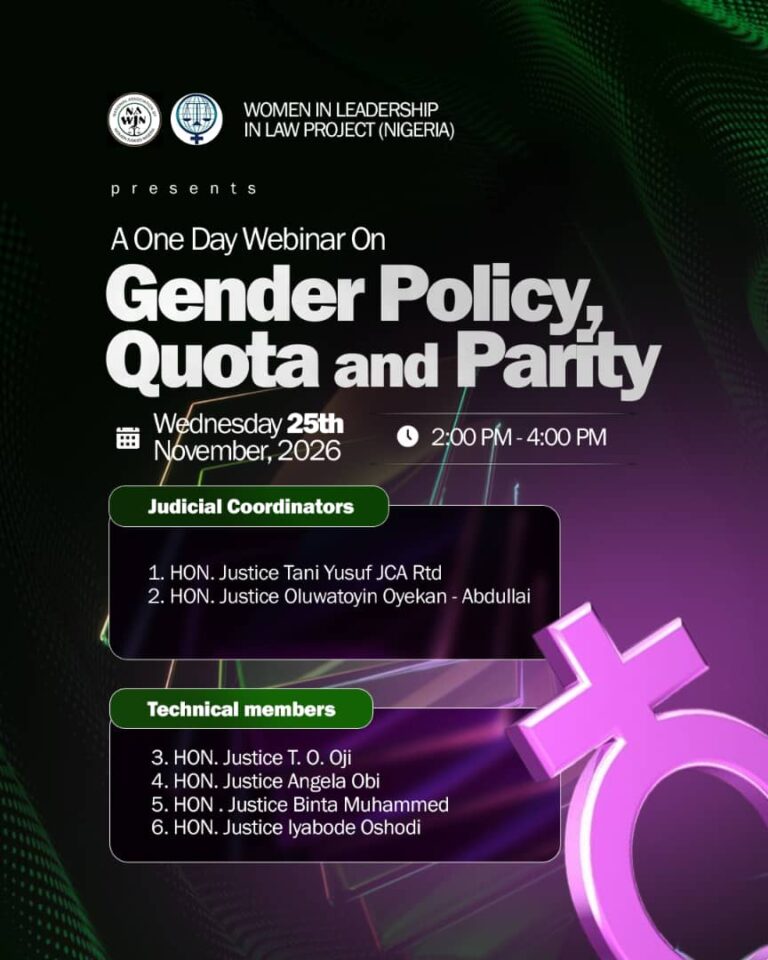

The webinar, titled Gender Policy, Quota and Parity, held on November 25, 2026, brought together judicial officers, legal practitioners, professional associations, gender advocates and other stakeholders to examine a proposed gender policy and explore practical strategies for its adoption across the states of the federation.
Scheduled for 2 pm to 4 pm Nigerian time, the engagement was designed to generate stakeholder input, critical review, and consensus on measures to address structural barriers affecting women’s professional advancement and representation in decision-making positions.
Participants included representatives of the Magistrates Association of Nigeria’s Women Wing, the Nigerian Bar Association Women Forum, the International Federation of Women Lawyers (FIDA), the African Women Lawyers Association, law officers, law teachers and other stakeholders.
The initiative builds on WILIL’s earlier engagement on mentoring, extending its focus on women’s leadership to institutional policies and recruitment practices that influence access to appointments, promotion and positions of authority.
Federal Character Act and Women’s Representation
A major focus of the webinar was the relationship between the Federal Character framework and the representation of women in public institutions.
Discussions examined how Nigeria’s constitutional and statutory commitments to equitable representation could be translated into practical measures that address the barriers women face in accessing public appointments.
The proposed gender policy is intended to address structural practices that may directly or indirectly disadvantage women in recruitment and appointment processes while promoting gender-responsive approaches across public and professional institutions.
Other areas of discussion included the legal and institutional foundations for gender quotas and parity measures, organisational reforms required to implement them, and strategies for securing adoption across the states.
Representatives of professional associations and women-focused organisations were also expected to contribute perspectives on the challenges confronting women in the judiciary, legal practice, public service and academia.
Judicial Officers Lead Gender Policy Initiative
The initiative is being led by Justice Tani Yusuf Hassan and Justice Toyin Oyekan-Abdullai, who serve as judicial coordinators.
The technical team comprises Justices T. O. Oji, Angela Obi, Binta Muhammed and Iyabode Oshodi.
The organisers targeted between 200 and 400 participants, including judicial officers, magistrates, lawyers, officials of federal and state Ministries of Justice, academics, gender advocates and civil society representatives.
Stakeholders to Develop Implementation Strategies
Beyond the discussions, the expected outcomes include documented stakeholder feedback on the proposed policy, recommendations for strengthening its provisions and implementation strategy, and identification of advocacy channels across states and professional institutions.
A post-webinar report is also expected to document recommendations and agreed next steps to guide further refinement of the policy and mobilisation of institutional support.
The engagement reflects growing attention to the need to move beyond mentoring and leadership development towards addressing institutional structures that determine women’s access to professional opportunities.
While mentoring, professional networks and leadership training remain important, the organisers are emphasising the need for measurable institutional reforms in recruitment, appointments, promotion and leadership selection.
The success of the proposed policy will ultimately depend on the extent to which institutions adopt practical measures, monitor compliance and ensure accountability for gender-responsive representation.
Through the initiative, NAWJN and WILIL seek to strengthen stakeholder support for gender parity and advance women’s participation in leadership and decision-making across Nigeria’s legal profession and public institutions.
Read More:
Women in Law Take Gender Parity Debate to Recruitment


behind Games Village, Abuja
5A, CGH, Games Village, Abuja