

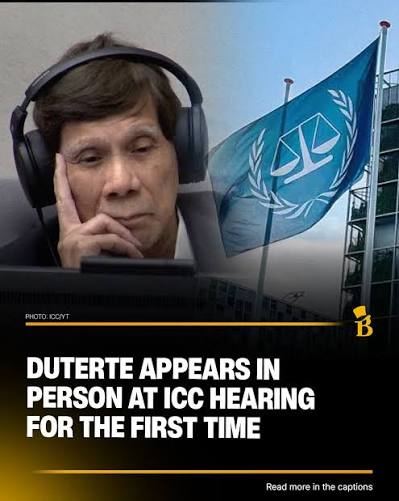
Former Philippine President Rodrigo Duterte is expected to appear before the International Criminal Court in The Hague today, Wednesday, September 16, in what would be his first public appearance in more than a year.
The Associated Press reports that the presiding judge in Duterte’s case indicated that the former president was expected to attend the pretrial hearing. Duterte faces allegations of crimes against humanity linked to killings associated with his anti-drug campaign.
The 81-year-old former president had missed a series of previous proceedings, with medical grounds cited for his absence. ICC judges, however, ruled earlier this year that he was medically fit to stand trial.
The prosecution’s case concerns alleged killings connected to Duterte’s anti-drug policies, including periods when he served as mayor and later as president of the Philippines. Duterte has denied criminal responsibility.
A central jurisdictional question surrounding the proceedings has involved the Philippines’ withdrawal from the Rome Statute, the treaty establishing the ICC. The court’s position is that withdrawal does not necessarily extinguish jurisdiction over alleged crimes falling within the court’s jurisdiction while a country was still a State Party.
The proceedings are legally significant beyond Duterte himself. They test the reach of international criminal accountability over former heads of state and the continuing consequences of alleged crimes committed during a state’s membership of the ICC.
The hearing should not be confused with a conviction or final finding. Duterte remains an accused person, and the prosecution bears the burden of establishing the case through the procedures prescribed under the Rome Statute.
For Nigerian readers, the proceedings also provide useful context for recent domestic debate around the ICC. LegalLinkz recently reported the dismissal of an anonymous communication seeking an ICC investigation into alleged systemic kidnappings in Nigeria, a development which generated discussion about the court’s jurisdiction, admissibility requirements and the principle of complementarity.
That principle gives national justice systems primary responsibility for investigating and prosecuting crimes, with ICC intervention subject to the conditions established under the Rome Statute.
Source: Associated Press — Duterte Expected in Court in The Hague
RELATED ON LEGALLINKZ: ICC Dismisses Nigeria Kidnapping Petition
