


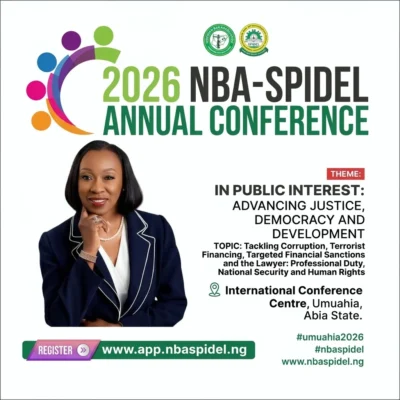
At the 2026 Annual Conference of the Nigerian Bar Association Section on Public Interest and Development Law (NBA-SPIDEL), I had the opportunity to participate as a discussant on the topic
“Tackling Corruption, Terrorist Financing, Targeted Financial Sanctions and the Lawyer: Professional Duty, National Security and Human Rights”.
I considered it an important opportunity to reflect on the changing responsibilities of legal practitioners and the critical role we must play in ensuring that our professional services are not used to facilitate criminal activities.
First, I must specially acknowledge and commend the Chairman of NBA-SPIDEL, Mrs Uju Agomo, for the kind invitation to participate in the discussion. I particularly appreciate her outstanding leadership and deliberate commitment to collaboration and institutional partnership within the NBA. Her participation in our NBA Section on Legal Practice Conference, as well as her continued encouragement of joint webinars and other collaborative initiatives, demonstrates the value of collegiality and mutual support across our various sections.

In my intervention, I emphasised that lawyers occupy a unique position in society. As officers of the court, advisers to clients and facilitators of commercial transactions, we are entrusted with responsibilities that include company formation, asset management, establishment of trusts and property transactions.
While these are legitimate professional services, they can also be exploited to disguise ownership of assets, move proceeds of crime, and give legitimacy to questionable transactions. This makes the legal profession an important gatekeeper in the fight against corruption, money laundering and terrorist financing.
I drew particular attention to the Rules of Professional Conduct for Legal Practitioners 2023, which introduced specific obligations relating to Anti-Money Laundering and Combating the Financing of Terrorism (AML/CFT).
I highlighted Rules 57 to 72, which address specified transactional services, client and transaction record-keeping, targeted financial sanctions, risk assessment, client due diligence, suspicious transaction reporting, education and awareness.
My position is that AML/CFT compliance can no longer be regarded as an obligation belonging exclusively to banks and financial institutions. Legal practitioners must understand and discharge their applicable responsibilities, as failure to comply may constitute professional misconduct.
I also stressed the importance of taking Know Your Client (KYC) procedures and client due diligence seriously. We must move beyond simply obtaining a client’s name, telephone number, and identification document. We must understand who we are acting for, identify beneficial owners, establish the source of funds where required, and understand the commercial purpose of transactions.
I also cautioned that being a politically exposed person does not automatically make an individual a criminal. It simply calls for appropriate risk assessment and due diligence. That distinction is important.
On targeted financial sanctions, I encouraged law firms to establish proper screening mechanisms against the United Nations Consolidated List and the Nigerian Sanctions List. Such screening should, where relevant, extend to beneficial owners, directors, counterparties and other connected persons.
Where potential matches arise, they must be properly investigated and resolved, while confirmed designations must be handled in accordance with applicable freezing and reporting obligations.
However, I consider it equally important that our determination to combat corruption and terrorism must not undermine the fundamental principles that underpin the legal profession.
A lawyer’s duty to a client does not disappear because that client is accused of corruption, money laundering or terrorist financing. Every person is entitled to legal representation, and the right to a fair hearing and access to justice must remain protected.
There is a difference between representing a person accused of money laundering and helping that person conceal the proceeds of money laundering. Our responsibility is to defend our clients within the bounds of the law, not to become instruments through which the law is circumvented.
I therefore emphasised the need to maintain a balance between vigilance without prejudice, compliance without compromising the independence of the Bar, and national security without undermining fundamental human rights.

I also called on the Nigerian Bar Association to strengthen awareness and practical training on AML/CFT obligations across its branches and sections. The NBA must provide practical guidance and compliance templates, encourage appropriate internal compliance procedures within law firms and work constructively with SCUML, the NFIU and other relevant authorities.
Particular attention should be given to small and medium-sized law firms to ensure that compliance requirements are understood and can be implemented in everyday legal practice.
In my view, this should be approached as an exercise in professional development and self-regulation rather than simply enforcement and discipline. We must educate our members, equip them with the necessary tools and, where necessary, hold those who knowingly facilitate criminal activity accountable.
The fight against corruption, money laundering and terrorist financing requires the cooperation of every institution, including the legal profession. However, our role is not to become investigators or law enforcement officers. Our responsibility is to ensure that our professional services are not knowingly used to facilitate criminal activity while remaining committed to justice, professional independence, confidentiality and the protection of human rights.
I concluded my intervention with a point I consider fundamental to the future of our profession:
“A lawyer must never become an instrument for legitimising the proceeds of crime. But neither must the fight against crime become an excuse for undermining the independence of the legal profession or denying anyone the right to legal representation.”
That, in my view, is the balance we must strike.
Folashade Alli, SAN
Chairman, NBA-SLP
RELATED NEWS
-
Notice to All Lawyers in Nigeria on Compliance with Anti-Money
-
NBA President Mazi Afam Osigwe, SAN, Leads Anti-Money Laundering
-
NBA President Demands Accountability Within the Bar


behind Games Village, Abuja
5A, CGH, Games Village, Abuja